
Ask someone in a downtown condo what rural life looks like, and you will get a specific picture: a porch at sunset, a fishing rod against a fence, an unbearable amount of quiet. The silence. The simplicity. What you will not hear mentioned is boredom.
But ask someone who recently traded a city apartment for ten acres and a wood stove, and you will get a more complicated answer. That silence that felt like freedom in August can feel like a vacuum in February. The nearest cinema is an hour away. Friends do not drop by unannounced, because unannounced means a forty-minute drive. Rural life is not inherently boring, but it does ask a question that city life rarely poses with such insistence: what are you going to do tonight?
The answer, as it turns out, has changed more in the last five years than it did in the previous fifty.
The Myth of the Idle Countryside
Rural Canada has been growing steadily: between 2021 and 2025, the population of rural and small towns increased in 10 of 13 provinces and territories, with 80,100 people moving outside major metro areas in 2025 alone – the largest small-town share of growth in at least 25 years. The pandemic-era migration was not a blip.
What rural life lacks is not activity, it is ambient activity. In a city, a free evening fills itself. In the country, it has to be built.
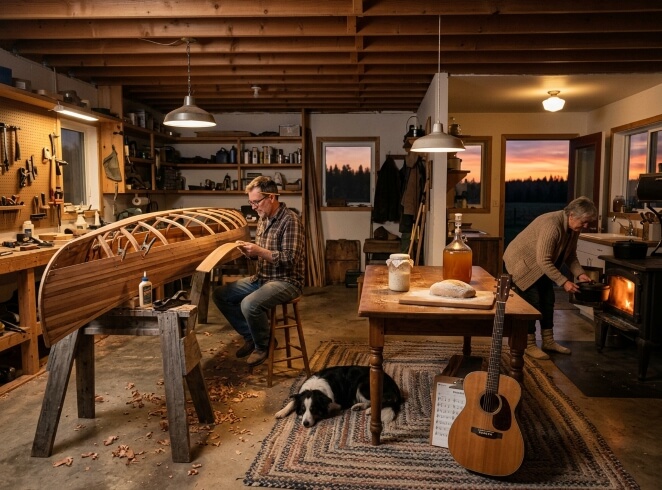
That is why rural homes accumulate projects. The half-built canoe. The sourdough starter. The guitar that finally gets attention because there is no alternative. Woodworking, canning, home brewing – these blur the line between work and play in a way a city gym membership never will.
Rural social life is deliberate rather than ambient, and for many, that makes it more satisfying. The community hall potluck. The neighbour who drops by not because they were passing, but because they decided to. These become the scaffolding of a social life that feels more intentional than city socializing ever did. They also require effort. No one texts you about the potluck unless you are already on the list.
When the Internet Arrives, Everything Shifts
Until recently, the digital divide made rural entertainment a fundamentally different proposition from urban. Streaming was choppy. Video calls froze. Online gaming disconnected. That divide has narrowed sharply. By July 2025, Starlink alone reported more than 500,000 subscribers in Canada, making the country one of its largest markets outside the United States. Meanwhile, by mid-2025, more than one-quarter of service-sector businesses in Canada’s rural labour markets anticipated offering remote work arrangements, a 19.2% year-over-year jump, which means broadband is no longer a luxury for rural households, but a utility.
What does that mean for a rural evening? It means streaming works. It means online gaming, video calls with family, YouTube tutorials for fixing the tractor, and the ability to work a city job while living a rural life. The same connection that lets a homesteader take an online welding course or watch a documentary also delivers the full ecosystem of digital entertainment, from streaming and online gaming to more niche forms of entertainment that barely existed in the original homesteading handbook.
When the Screen Brings Everything Home,Including Online Casinos
Improved rural internet delivers the full digital entertainment ecosystem. That now includes everything from streaming and multiplayer games to platforms like online casinos.
By September 2025, wagers on Canada’s regulated iGaming platforms reached $8.55 billion in a single month, 86% of that on casino games, with 1.17 million active player accounts. By early 2026, mobile devices accounted for over 70% of all online casino traffic in the country.
For a household thirty kilometres from the nearest town, with no physical casino within driving distance, the phone on the kitchen table becomes the only point of access. The same screen handles weather forecasts, seed orders, and a half-hour of blackjack before bed. It’s not a separate activity, it’s part of the same digital evening that includes streaming, social media, and video calls.
With Starlink surpassing 500,000 Canadian subscribers and rural broadband reaching near-universal coverage, the gap between a city evening and a rural one has essentially closed. Online casino play is simply one more option in the menu of screen-based leisure, as ordinary in the country now as it is anywhere else.
What Actually Works
Ask long-time rural residents what keeps winter from feeling claustrophobic, and they will tell you something almost old-fashioned: have a project. Not just work, work and rest is a city rhythm, but the kind of project that absorbs you. Restoring furniture. Learning an instrument. Building something you do not urgently need.
The homesteaders who report the highest satisfaction after five or ten years treat screens as a tool rather than a lifestyle. They watch a film, video-call their children, look up how to fix the well pump. And then they close the laptop and do something with their hands.
Rural life is not boring, but it will not entertain you automatically. The difference between those two versions of rural life is not geography. It is intention, and that is a choice every household makes, one evening at a time.