
Most homesteading resources tell you what it looks like. We tell you what it takes. Modern Homesteading today covers self-sufficient rural living in Canada – food, heat, animals, shelter – from people who are still figuring it out alongside you.
5.9M
Canadians living in rural and small-town areas (Statistics Canada, 2021 Census), a number that has grown every year since
10 of 13
Canadian provinces and territories where rural population grew between 2021 and 2024
The Real Definition of Modern Homesteading
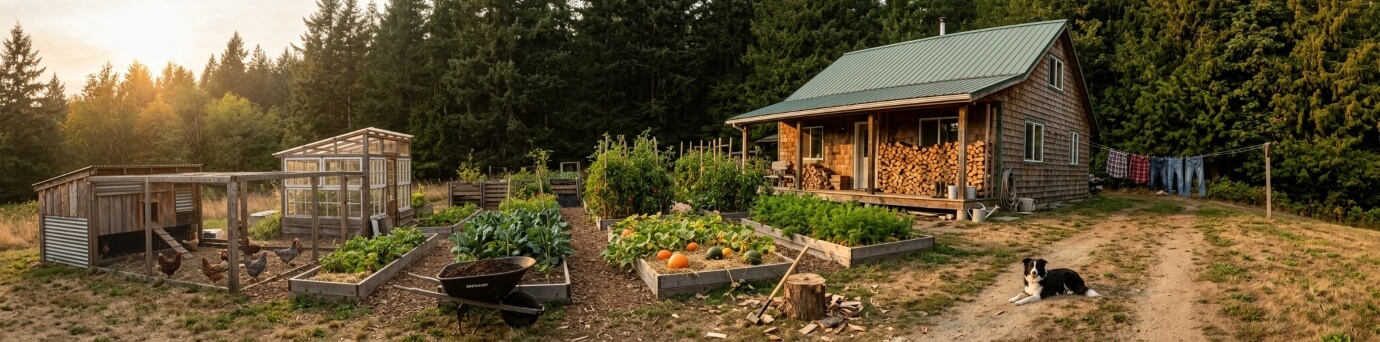
Modern homesteading is not a recreation of 19th-century frontier life. When Canada’s Dominion Lands Act granted settlers 160 acres of prairie in 1872, self-sufficient living wasn’t a lifestyle choice. It was the only option. Everything had to come from the land or not at all. We choose our level of involvement. That distinction matters.
The working definition: a household that actively works to produce some portion of its own food, manage its own heat, and reduce dependence on industrial supply chains, to whatever degree its land, time, and resources allow. The spectrum is wide. One end looks like a family growing tomatoes in raised beds on a half-acre lot outside Gibsons. The other looks like a couple heating a log cabin entirely with wood from their own woodlot, eating almost entirely from their own land. Most homesteaders land somewhere in the middle, and that position shifts over time. Ours certainly did.
The direction of effort is what defines it, toward production rather than consumption, toward local rather than industrial, toward skills rather than services.
What we’ve built here is closer to a homesteading magazine than a traditional blog – practical, research-backed, and grounded in real experience. Our mission is straightforward: give people the honest, specific information that most homesteading resources skim over. Not what it looks like in photographs. What it takes.
The Core Skills: Food, Heat, Animals, and Shelter
Self-sufficient rural living in Canada organises around four areas. Each one is approachable on its own. Together, they form a system, and we’ve found that learning them in parallel, even slowly, produces better results than going deep on one and ignoring the others.
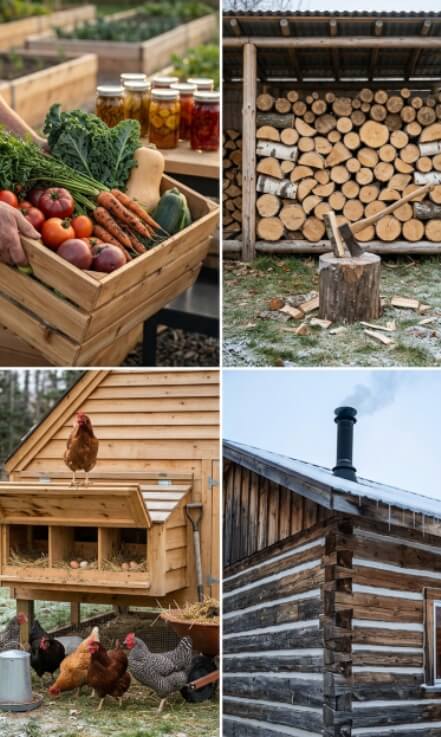
Food is usually where people start, and where we started too. A well-managed 1,000-square-foot raised bed garden produces 200–300 pounds of vegetables per season in coastal BC. Food preservation (canning, dehydrating, salting, and smoking) extends that harvest through winter without continuous electricity. Root cellars have stored root vegetables and squash reliably in Canadian climates for centuries. The technique hasn’t changed, and it still works.
Heat is where the numbers matter most. A full cord of firewood stacked 4 ft × 4 ft × 8 ft, exactly 128 cubic feet, costs between $200 and $450 in most BC markets. A well-insulated 1,500-square-foot home typically burns two to three cords per winter. We learned to calculate this before the first of October, not after. Underestimate by a cord, and you’re scrambling for split wood at peak prices in December. It’s a mistake most people make once.
Animals are optional but common. Backyard chickens are the most frequent starting point – manageable in space, legal in most Canadian municipalities for hens, and they produce a tangible return quickly. Each laying hen produces roughly 250–300 eggs per year. Each also produces about 45 pounds of manure annually, useful as compost when managed correctly, a genuine problem when it isn’t. We started with chickens. Most homesteaders do, and most don’t stop there.
Shelter covers the structures that make rural life functional: older homes, wood stove installation, insulation that works when grid heating fails, water systems that don’t freeze in January. Heritage log cabin restoration is its own discipline – one we’ve documented in detail, combining structural knowledge with an understanding of how traditional materials behave over decades.
Homesteading in Canada: What Changes by Region
Homesteading in Canada looks different depending on where you are. We’ve focused primarily on coastal British Columbia, but we’ve connected with homesteaders across the country and seen what the regional differences actually mean in practice.
Coastal British Columbia offers mild winters and an extended growing season, but wet springs complicate soil conditions, and slug pressure is relentless. Wood heat is practical year-round. The province’s Agricultural Land Reserve (ALR) restricts non-agricultural development on designated rural land, something we’ve seen catch many first-time rural buyers completely off guard.
The Prairies offer deep fertile soil and long summer days but a short growing season, early frost, and consistent wind exposure. Water access in freeze-up conditions requires planning that coastal homesteaders rarely face.
Ontario and Quebec saw the highest net city-to-rural migration in Canada between mid-2023 and mid-2024. Both provinces balance reasonable growing seasons with harder winters and have seen sharp increases in demand for rural properties since 2020.
Across all regions: rural emergency response times run 3 to 4 times longer than urban averages. Healthcare access often requires long drives. Rural internet is improving but remains inconsistent outside major corridors. We mention this not to discourage, but because we wish someone had told us earlier. These are planning inputs, not deal-breakers.
Legal considerations vary by municipality and province. Livestock bylaws, water rights, secondary structure permits, and ALR zoning are the four areas where we’ve seen new rural landowners encounter unexpected restrictions most often. Verifying each before purchase takes a few hours and prevents years of problems.
Where to Start: A Realistic First Year
The advice we give every person starting this journey is the same: choose one or two skills and go deep, rather than attempting everything at once. We tried to do it all in our first year. We didn’t do any of it particularly well. The second year was better because we were more honest about capacity.
A useful first year might look like this:
- One food project – a vegetable garden, or one batch of preserved tomatoes, or both at a manageable scale
- One heat project – learning to identify, buy, split, and stack firewood correctly, and calculating how much a specific house actually needs
- One structural project – understanding the water system and how it behaves in a hard freeze
Three things. Done well, they build genuine competence. Done badly, which is expected and fine, they build the kind of understanding that no book produces. The second year is easier than the first in almost every case. The third year, easier again.
Finding someone who has already navigated the first few years shortens the learning curve more than anything else we’ve found. Local agricultural extension offices, farming associations, and regional homesteading communities are more useful for this than most published guides. The knowledge that matters most in this life is held by people who learned it with their hands, not from a screen.
FAQ: Modern Homesteading in Canada
The practice of increasing household self-sufficiency through food production, food preservation, animal keeping, and related skills. It exists on a spectrum from urban container gardens to full off-grid rural operations. It’s chosen rather than required, and the level of commitment is set by the household, not by any external standard or purity test.
Yes. Rules around livestock, water rights, land use, and structures vary by province and municipality. BC’s Agricultural Land Reserve restricts non-agricultural development in designated zones. Bylaws around backyard chickens differ even between neighbouring municipalities. Always verify local rules before purchasing property or acquiring animals.
Less than most people assume. Meaningful food production is possible on a standard urban lot. Chickens require as little as 10 square feet of coop space per bird inside. A half-acre supports a substantial garden, fruit trees, and small livestock comfortably. Larger acreage matters most for a firewood lot, hay storage, or larger animals. Many serious homesteaders in Canada work 2 to 5 acres.
Yes, and most people do. The majority of Canadian homesteaders maintain employment while developing their systems over several years. The idea that homesteading requires quitting everything immediately is one of the most persistent and most damaging misconceptions about it. A slow, deliberate transition over two or three years is far more likely to succeed than a sudden one.
Food preservation and firewood basics have the highest practical return and the lowest barrier to entry. Both produce tangible results quickly and teach skills that compound over time. Chicken keeping is a useful early step if local bylaws allow it. Flock management, log cabin maintenance, and emergency preparedness build naturally from those foundations.
What You’ll Find Here
Below is everything this site covers in detail. All content is original, factual, and written from direct experience.
Firewood & Wood Heat | Cord of wood measurements, BTU by species, seasoning, storage, wood stove efficiency |
Chicken Sounds | Vocalization reference – alarm calls, egg song, broody hens, distress signals |
Adjusting to Rural Living | City-to-country transition, the first year, what actually changes |
Backyard Chickens | Getting started, breeds, coop basics, chicken facts and poop management |
Backyard Chickens | Adding a rooster, raising chicks, predator protection (coyotes, hawks) |
Flock Management | Rural property research, real estate checklist, ALR zoning, pre-move planning |
Moving to the Country | Skills, mentorship, children in the country, long-term honest assessment |
Rural Living | Heritage cabin restoration, small-space interior design, cast iron sink refinishing |
Log Cabin & Homestead Decor | Heritage cabin restoration, small-space interior design, cast iron sink refinishing |
Food Preservation | Canning, dehydrating, salting, smoking, root cellar storage, living without refrigeration |
Emergency Preparedness | Power outages, wildlife conflicts, off-grid communication, rodent control in rural kitchens |
About this site: modernhomesteading.ca is not affiliated with the domain’s previous blog author and their content. This is an independent publication run by a new editorial team – another, different modern homesteading blog, built around practical experience rather than aesthetics.
We write from experience: people who have made the move from city to country, heated with wood, kept chickens, canned tomatoes, and learned most of what we know the hard way. Our focus is practical guidance for anyone on a modern homesteading journey: rural living, food preservation, raising animals, and building resilience. This is what we do. This is what we share.