
Between July 2024 and July 2025, Quebec gained 15,714 residents who moved from cities to rural and small towns within the province. Ontario was almost identical at 15,412. These are not small numbers, and they follow four consecutive years in which rural populations grew in 10 of Canada’s 13 provinces and territories, a reversal of a trend that ran the other way for generations.
The reasons are not romantic. Housing is the primary driver: a one-bedroom apartment in Vancouver averaged $2,671 a month in June 2024. Toronto was $2,479. For households whose incomes don’t scale with those costs, moving from city to country is increasingly a financial calculation, not a lifestyle statement. Some people also move for space, slower pace, or the specific goal of producing food and heating with wood. Most move for a combination.
City to country living involves two distinct phases. The first is the decision and preparation. The second is adjustment to what the move actually produces. For people still in the planning phase, moving to the country and rural property research covers the due diligence side in full. For people already through the move, rural living day-to-day covers the adjustment period specifically.
Why People Move to the Country, and What Actually Drives It
The 2024 Angus Reid survey asked Canadians why they were considering leaving their current province. Housing affordability came first cited by 28% of all respondents. For new Canadians who had lived here less than a decade, that number rose to 39%. Quality of life, cost of living generally, and healthcare access followed.
The people who adjust well to rural life are usually not purely motivated by cost. Cost alone doesn’t prepare anyone for what moving from urban to rural actually requires. The people who tend to stay are those who came with a set of things they wanted to do on that land – grow food, heat with wood, keep animals, run a home-based business – and treated the cost advantage as enabling that, rather than as the entire point.
The move from city to country is not primarily a housing transaction. It is a change in how daily life is organised: how you get food, how you stay warm, how far you drive for basic services, and how much of the infrastructure you previously took for granted you now have to manage yourself.
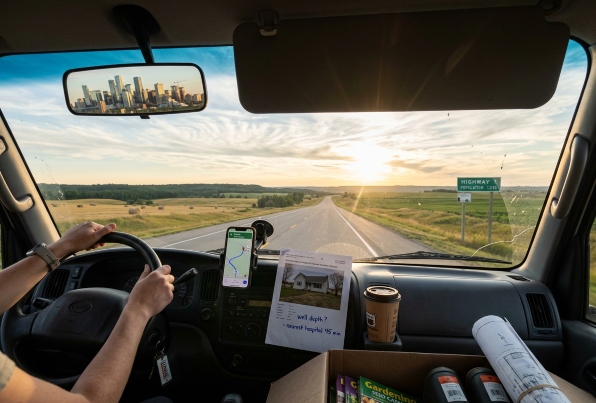
City to Country: The Transition Nobody Fully Prepares For
The city to country transition has a predictable shape. Most people describe the first season as a series of small surprises, not catastrophes, but consistent recalibrations. The ones that catch people most often: winter road conditions, distances, and the pace of getting things done.
In urban Canada, most daily needs – grocery store, pharmacy, hardware store, clinic – are within a 15-minute drive or a transit connection. In rural Canada, 2 in 5 households lack access to basic services within 15 km of their home (Statistics Canada, 2024). You stop making one-item trips. You batch errands. You keep more on hand. This is a genuine behavioural shift and it takes a few months to become natural.
Road conditions in winter are another recalibration. Rural roads are maintained less frequently than urban ones. A snowfall that causes minor inconvenience in a city can make a rural road impassable for a few hours. And if a vehicle breaks down, the wait is longer.
The unexpected advantage in the transition period: structural time. The commute disappears. The density of scheduled obligations that urban life generates, the constant proximity to events, appointments, and social obligations, reduces substantially. Many people describe a surprising reclaiming of hours they didn’t know they were spending.
The First Six Months of Rural Living
Six months in, city transplants consistently describe four things that shifted:
- Physical capacity. Rural properties require work that urban life does not demand. Stacking firewood, maintaining a kitchen garden, dealing with livestock, clearing snow from a long driveway. Most people underestimate the physical adjustment.
- Practical knowledge gaps. What to do when the well pump stops. How to read whether a tree is structurally sound. How to split wood without injuring yourself. Urban life doesn’t require any of this knowledge. Rural life does, and most of it has to be learned in the first year.
- Social landscape. Rural communities are smaller and more connected than urban ones, in ways that can be both supportive and intense. Neighbours know who you are quickly. There is often a genuine reciprocity, people help more freely, and expect more freely in return.
- Relationship to weather. In a city, weather is a topic. In a rural area, it is a factor in planning. When to cut firewood. Whether to drive to town this morning or wait until the road is ploughed. Weather becomes a variable in daily decisions in a way that is absent from urban life.
The first winter is the hardest for most people – not because of the cold itself, but because it is the first full-scale test of whether the property’s systems are adequate and whether preparation was sufficient. Running short of seasoned firewood in February is entirely preventable and extremely common in the first year.
For the practical side of wood heat, how much firewood a house actually needs, what a cord of wood is, and how to stack and season correctly, see firewood basics and cord of wood explained.
Rural Lifestyle vs. Urban Lifestyle: What the Data Shows
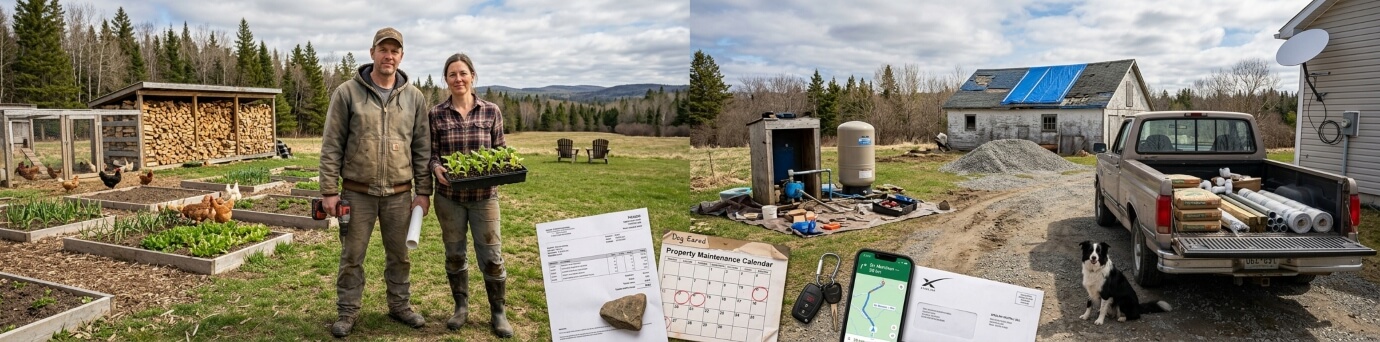
Rural lifestyle appreciation, the reason people stay rather than leave, tends to be specific rather than general. People describe specific things: being outside more, eating food they grew, working on projects with tangible results, not spending three hours a day in a car.
Against those gains, the data on rural infrastructure is clear. About 20% of Canadians live in rural communities, but only 8% of physicians practice there (Canadian Medical Association, 2025). Rural Canadians travel an average of over 35 km to see their doctor and 30 km to reach the nearest hospital, more than double the travel of urban patients. Rural ED closures in BC alone accounted for more than 120 lost access days in 2022.
Internet access has improved substantially since 2020. Starlink covers 100% of Canada, operating at 50–220 Mbps download speeds for CAD $140/month with a one-time $759 hardware fee (2025 pricing). Traditional rural providers offer $80–120/month for speeds under 25 Mbps in areas with existing tower coverage. For remote properties with no tower access, Starlink is the realistic option.
What the data doesn’t capture: the cost and time of maintenance that urban renters and condo owners never encounter. Septic systems, wells, driveways, roofs on older structures, heating systems, snow removal equipment. These are real recurring costs and real recurring demands on time.
What to Research Before You Move, and What You Can’t Know in Advance
The most important pre-move research covers four areas. Healthcare access: the nearest GP, the nearest hospital with an emergency department, and how often that ED is actually open. Internet connectivity: check the specific property address against Starlink’s tool and existing tower maps, don’t rely on general regional availability. Zoning and ALR: in BC, the Agricultural Land Reserve affects a large portion of rural land and can restrict structures, businesses, and uses. Water and septic: whether on a well or municipal water, the age and condition of the system, and whether there’s a history of issues.
What cannot be known in advance: how the property performs in its first hard winter, what the neighbours are actually like, whether the nearest tradespeople are responsive, and how much the isolation affects the people in the household differently. These are real variables and they cannot be fully assessed from a distance.
The Rural Life You Imagined vs. the Rural Life You Get
Most people who move from city to country arrive with a mental image of productive gardens, warm fires, quiet mornings, and a simpler relationship with time. All of these things are available in rural life. None of them come automatically or immediately.
The adjustment period is most difficult for people who expected rural life to be passive – a retreat rather than an engagement. The people who adapt fastest are those who came to do specific things and tolerate the learning curve of doing them badly at first.
Rural living requires a dramatic change in how daily life is organised. Not a harder life necessarily, but a different one, with a different distribution of effort and reward. The people who find this immediately obvious are the ones who stay.
Children adjust differently than adults. Younger children often adapt faster than their parents – space and outdoor access are immediate gains for them. Teenagers adapt more variably, depending on how much of their social life depended on urban density. This is worth thinking through honestly before the move.
When It Works – and When People Go Back
People who make the move from city to country and stay tend to share a few things: a clear idea of what they wanted to do on the land, research done on infrastructure realities before committing, and a realistic timeline of two or three years rather than one season before deciding whether the life suited them.
People who go back tend to cite the same smaller set of reasons: isolation that became untenable for one household member but not the other, healthcare access anxiety they hadn’t anticipated, inability to generate enough remote income, or physical demands that exceeded what their health allowed. None of this signal failure, they signal information that was unavailable until the move happened. The Toronto census for 2024/2025 recorded the first net population decline in the city’s modern history, the outflow from major urban centres is real. But so is the return flow.
The honest number: it’s not publicly tracked how many people who move from urban to rural return within five years. Anecdotally, the consensus estimate among homesteading communities is roughly one in four or one in five. The majority stay.
Still Planning or Already There? What to Read Next
The move from city to country divides into two things that require different kinds of preparation. Property research, legal due diligence, financing, and timing are covered on the planning page. Skills, community, first projects, and rural mentorship are covered on the rural living page.
A good starting point for most households moving from urban to rural: pick one or two practical projects in the first year and go deep on them. Backyard chickens are the most common first rural project – manageable in space, legal in most municipalities for hens, and productive within a few months. Wood heat is the second most common, and the one with the highest upside: a properly run wood stove removes heating dependence on the grid entirely.