
Backyard chickens are the most common first step in any homesteading journey. They are manageable in space, legal in a growing number of Canadian municipalities, and productive within a few months of setup. Raising your backyard flock is approachable. But there are a few things most beginner guides omit, including 45 pounds of poop, a 2-year productive lifespan, and a cloaca. Everything here is designed to help you decide whether or not to get chickens for your backyard before you commit.
How Much Space Do Backyard Chickens Need?
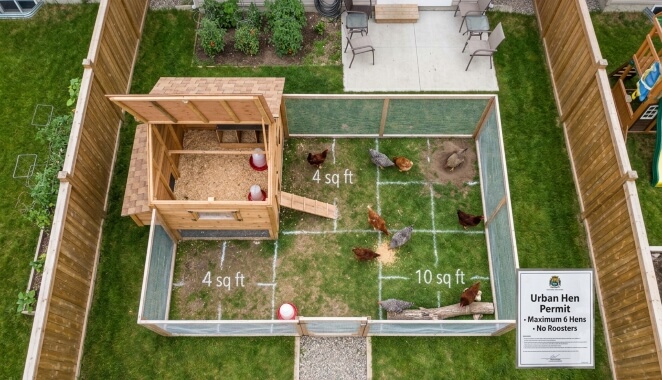
Are you ready for chickens? Chickens 101 starts here. 4 square feet per bird inside the coop, 10 square feet per bird in the outdoor run. Those are the standard minimums. Below those numbers, and chickens will begin expressing stress through feather pecking and aggression.
Most Canadian cities that permit backyard chickens allow a maximum of 4 to 6 hens on a residential property. Roosters are almost universally prohibited in urban bylaws due to noise. Kingston permits up to 6 hens with a $31 annual permit. Vancouver, Kitchener, Edmonton, Surrey, and Victoria all have active urban hen programs. Rules change between municipalities, even between neighbouring townships in rural Ontario. Check your specific address before acquiring any birds.
The BC SPCA recommends keeping a minimum of two hens. Chickens are social animals and do not do well in isolation.
Chicken Poop: 45 Pounds Per Hen Per Year – and What to Do with It
Chickens can poop a lot – specifically, about 45 pounds per hen per year. Hens produce about 45 pounds. That is not a manageable side effect, it is a planning input. Fresh chicken manure cannot go directly onto plants: it is high in ammonia, contains pathogens including Salmonella and E. coli, and will burn plant roots if applied raw. It must be composted first.
Daily coop cleaning prevents odour buildup and fly pressure. Manure must be stored in a covered, enclosed container – Kingston’s bylaw caps on-property storage at no more than 2.8 cubic feet at any time. Regulations in most municipalities require secure storage and regular removal. The compost section at the end of this page covers how to convert that 45 pounds into usable garden fertilizer.
ISA Brown vs. Other Laying Breeds
The ISA Brown is not a true breed. It is a proprietary hybrid, developed in France in 1978 by Institut de Sélection Animale. The exact genetic formula is a trade secret. What is known: it crosses Rhode Island Red–type lines to produce a sex-linked bird that lays approximately 300–320 large brown eggs per year, starts laying at 20–22 weeks, and produces a predictable commercial result.
The trade-off is lifespan. ISA Browns typically live 2–4 years, significantly shorter than heritage breeds, which often reach 5–8 years. Their reproductive systems are under constant strain from year-round laying, with no seasonal rest period. Most keepers can expect strong production for two years, then a sharp decline.
Characteristic | Characteristic |
|---|---|
Eggs per year | 300–320 (ISA Brown) vs. 150–250 (most heritage) |
Point of lay | 20–22 weeks (ISA) vs. 24–30+ weeks (heritage) |
Peak production period | ~2 years (ISA) vs. 3–5 years (heritage) |
Typical lifespan | 2–4 years (ISA) vs. 5–8 years (heritage) |
Broodiness | Rarely broody (ISA) vs. varies by heritage breed |
Temperament | Docile, beginner-friendly (both) |
Feeding Backyard Chickens: The Diet, the Supplements, the No-List
Commercial layer pellets are the main diet for laying hens. A minimum of 16% protein content supports consistent egg production. Calcium supplementation, crushed oyster shell available free-choice from around 18 weeks, prevents thin-shelled eggs and calcium depletion from bones.
Do not feed chickens: avocado (toxic in all parts), chocolate, onions, raw potato skins, dried or raw beans, and mouldy food of any kind. Citrus is controversial – some sources flag it, others report no issue in small amounts. Err toward avoidance.
Chickens are omnivores and will eat insects, small frogs, and kitchen scraps, including cooked meat. Garden weeds, grass, and vegetable trimmings are acceptable and often enthusiastically received. Grit, small stones that aid digestion, should be available free-choice, especially for birds that are not free-ranging on natural soil.
Coop Basics: Size, Ventilation, and Predator Proofing
Ventilation is the most commonly underestimated coop requirement. Chickens produce significant moisture and ammonia from respiration and manure. Without adequate airflow, respiratory illness develops quickly. Vents should be positioned near the roofline to allow air movement without direct drafts on roosting birds.
Nest boxes: one box per three to four hens is the standard ratio. Hens will compete for the same box regardless of how many are available, but below this ratio creates queue-related stress. Nesting material (straw, wood shavings, or similar) should be replaced regularly.
Predator proofing matters more than most new keepers expect. Hardware cloth (welded wire, ½-inch openings) is required for any opening – chicken wire keeps chickens in but does not keep predators out. The floor of the run should either be hardware cloth buried 12 inches underground or a concrete apron to prevent digging. In coastal BC, Cooper’s hawks, raccoons, and mink are common threats. For flock predator management in detail, see flock management.
Chicken Coop Names: How Keepers Name Their Coops (and Why)
Naming a chicken coop is more common than it sounds. A quick search returns tens of thousands of results: The Hen House, Cluck Inn, Feather Hilton, The Beak & Perch, Chick-fil-A (predictably popular), The Roost, and hundreds of farm-name variations. It is a light tradition, but it has real search volume – “chicken coop names” draws consistent traffic, which suggests it is a question keepers actually ask.
Themed approaches dominate: puns on hotel names (Chick-in Inn, The Hen Hilton, The Eggstravaganza), celebrity chickens (Cluck Norris, Hennifer Lopez, Oprah Henfrey), and location references (The South Coop, The West Wing). Heritage-property keepers often name after the property itself or after the farm’s founding year. Some keepers name individual hens and the coop inherits the collective name over time.
Functionally, a named coop signals an engaged keeper. It also helps when talking to neighbours, who are more likely to respond warmly to “The Clucking Post” than to “my chicken structure.”
Odd Chicken Facts: Speed, Egg Biology, and Flock Behaviour
Can chickens run? Yes, up to 14–21 km/h (9–13 mph) in short bursts, depending on the bird. They are not fast by predator standards, which is why the alarm call, not their legs, is their primary defence mechanism.
Do chickens poop eggs? No. But they do use the same exit point for both. The cloaca is the single opening for the digestive, urinary, and reproductive systems in birds. Eggs and waste pass through it sequentially, not simultaneously. The egg is coated in a protective bloom (the cuticle) just before laying, which seals the shell against external contamination. The egg itself is never in contact with feces inside the body.
Chickens have a documented pecking order – a linear social hierarchy that determines feeding priority, roost position, and nest access. Introducing new birds disrupts this order and triggers visible conflict until a new hierarchy settles. Introductions go more smoothly when done at night, when birds are roosting and less reactive. See chicken sounds and what they signal for how this hierarchy is communicated vocally.
Chicken Poop as Compost: Nitrogen Ratios and Timing
Fresh chicken manure has an NPK ratio of approximately 1.8–1.4–0.8 (nitrogen–phosphorus–potassium) – higher in nitrogen than horse, cow, or steer manure. That nitrogen richness is the reason it cannot go straight onto plants and the reason it produces such valuable compost when handled correctly.
Hot composting: maintain a pile at 60–71°C (140–160°F) for at least 3 consecutive days, turning every few days. Ready in 5–6 weeks. This temperature actively kills E. coli, Salmonella, and most weed seeds. Use a C:N ratio of 2 parts brown material (straw, wood shavings) to 1 part manure.
Cold composting: leave the pile to break down passively. Minimum 6 months; 9–12 months is safer. Does not reach pathogen-killing temperatures, so the longer timeline is the safety mechanism.
Apply composted manure to soil no later than 90 days before harvest for trellised crops (tomatoes, cucumbers) and no later than 120 days for ground-contact crops (lettuce, carrots, strawberries). Source: University of Nevada Extension / USDA food safety guidelines.
Coop litter, the bedding mixed with manure from daily cleaning, is already a reasonable brown–green blend and compostes readily without additional carbon material in most cases.