
Losing a hen to a coyote is fast. One moment the flock is ranging, the next there is a scatter of feathers and a bird is gone. No carcass. No sound. Just absence. That scenario, and the hawk attack, the weasel in the coop at night, the pecking-order conflict that turns serious, is what flock management is actually about. The pleasant parts are straightforward. The rest requires a plan.
Rooster-to-Hen Ratio: The Numbers That Matter
The standard recommendation is 1 rooster to 8–12 hens in a standard backyard flock. The minimum for a backyard setup is 1 rooster to 4–6 hens. Below that threshold, hens will show visible signs of over-mating: bare patches on their backs and heads, avoidance behaviour, reduced laying. An over-bred hen is a stressed hen.
The ratio shifts by breed. Heavy breeds such as Brahmas and Orpingtons do best at lower ratios (1 rooster to 4–6 hens) because of their size and slightly slower pace. Active, lighter breeds such as Leghorns can sustain up to 1:12. Young cockerels (roosters under one year) are almost universally more rough than mature birds and need more hens around them to distribute that activity, not fewer.
Roosters are not strictly necessary unless you are breeding or want the alert and escort behaviour they provide to the flock. A rooster that ranges ahead of the hens, calls when he finds food, and sounds the alarm for hawks is a functional flock member. How chickens communicate those alarms is covered in detail on the chicken sounds and vocalizations page.
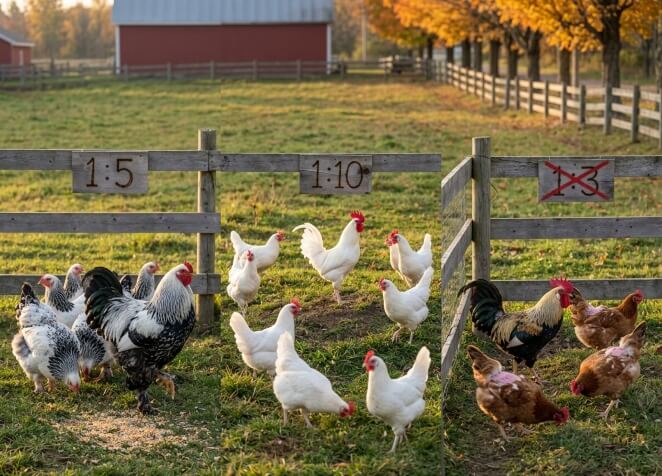
How to Introduce a Cockerel to an Existing Flock
Is the existing flock stable? That is the first question. Introducing a young rooster into a flock that is still sorting out its own pecking order creates compounding conflict. Wait until the flock has settled before adding any new bird.
The standard introduction method is a two-week visual separation. House the cockerel where the existing flock can see and hear him through a wire partition, but cannot reach him. This allows all parties to establish familiarity before physical contact. Direct introduction, simply placing a new bird in the existing coop, almost always results in injury to the newcomer.
Night introductions reduce aggression. Birds are calmer on the roost after dark. Placing the new bird on the roost overnight and allowing the flock to discover him at dawn, rather than seeing him arrive, tends to produce a less explosive initial reaction.
Young cockerels that have grown up alongside hens from chick age integrate almost without incident. The conflict happens when an adolescent or adult rooster is introduced into an established flock he has never met. Age and familiarity determine how much disruption follows.
Broody Hens Raising Chicks: What to Expect Week by Week
A broody hen will sit on a clutch for 21 days. During that time she barely eats or drinks and will lose noticeable body weight – up to 20% in some cases. She needs access to fresh water and food close to the nest; walking her far from the nest to eat is often enough stress to break the brood.
Week 1 post-hatch
The mother hen keeps chicks close and warm, brooding them frequently. Chicks learn food calls from her almost immediately. The hen will attack any bird – including birds much larger than her – that approaches the chicks. This is not aggression from the hen in the general sense; it is the brood-defence state that accompanies the hormonal shift of broodiness.
Weeks 2–3
Chicks become more mobile and begin to follow the hen further from the nest. The hen demonstrates foraging behaviour, pecking at food and calling the chicks to eat. Chicks learn what is edible from her directly during this window.
Weeks 4–6
The hen begins to lose patience with chicks that press themselves under her for warmth. By week 6–8, most hens actively discourage chick-dependent behaviour. The chicks are feathered and thermoregulating at this point and do not require it. The hen typically returns to normal flock behaviour and restarts laying within a few weeks of weaning the brood.
Coyote Predation Patterns and How to Reduce Risk
Coyotes take the bird and leave. If a hen is missing with no carcass, no blood, and feathers scattered over a wider area than would result from a ground-level struggle, a coyote is the most likely cause. This is the most reliable diagnostic: the absence of the body.
Coyotes (Canis latrans) are active year-round in BC and are seen increasingly during daylight hours in both rural and suburban areas, particularly during their breeding season beginning in February. The Conservation Officer Service in BC receives approximately 1,100 coyote-related reports per year, the majority in the Lower Mainland and Central Okanagan. They can jump a 6-foot fence, dig under barriers, and have a home range of 2–20 square miles. A flock that is attacked once will be targeted again if the access point is not addressed.
Mitigation: a fully enclosed and covered run is the most reliable deterrent. Coyotes that cannot reliably access a food source move on. A lockable coop door, closed at dusk, prevents overnight entry. Motion-sensor lighting around the coop disrupts the coyote’s preference for low-light approach.
Hawk Predation: Identifying the Evidence
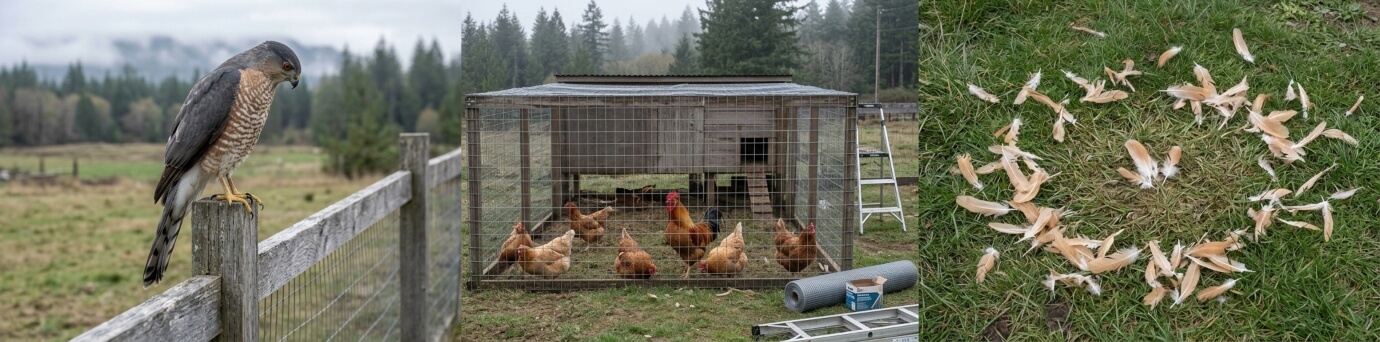
Hawks pluck and eat on site. The evidence of a hawk kill is the opposite of a coyote kill: the bird is there, the breast meat is consumed, and the feathers are cleanly plucked with no flesh clinging to the shafts. A hawk eats from a kill it cannot carry; a small or juvenile bird may be carried off entirely, leaving only a site with no body and no broad scatter of feathers.
The two most common daytime raptor threats on the BC coast are Cooper’s hawk and the red-tailed hawk. Cooper’s hawks are accipiter-class birds – agile, forest-adapted, and built to pursue birds through dense vegetation. They are crow-sized, hunt during the day, and will pursue a bird through an open coop door or wire gap without hesitation. Red-tailed hawks are significantly larger and primarily hunt small mammals, but will take a hen opportunistically, particularly young birds and bantams.
Hawks and eagles are federally protected under the Migratory Birds Convention Act in Canada. Killing, trapping, or possessing a bird of prey carries significant penalties. Physical barriers are the only legal deterrent. A covered run with roof netting or hardware cloth eliminates the aerial threat entirely.
A rooster that reliably sounds the aerial alarm gives hens the few seconds needed to reach cover. That alarm call is distinctive and different from the ground predator call – the flock responds to each one differently.
Building a Predator-Resistant Run: Hardware Cloth vs. Chicken Wire
Chicken wire keeps chickens in. It does not keep predators out. This is not a nuance – it is a material limitation. Chicken wire hexagonal mesh has openings large enough for a mink to squeeze through, large enough for a weasel, and weak enough to be torn through by a determined raccoon. Raccoons will also reach through chicken wire to grab a roosting hen’s head or foot.
Hardware cloth, welded wire with ½-inch square openings, is the correct material for any run wall, floor, or roof that is expected to stop predators. It is significantly more expensive than chicken wire and considerably more effective. The minimum recommended gauge is 19-gauge; 16-gauge is better for areas with heavy raccoon or mink pressure.
Barrier | Stops Raccoons | Stops Mink/Weasel | Stops Hawks | Cost |
|---|---|---|---|---|
Chicken wire (hex mesh) | No | No | If covered | Low |
Hardware cloth (½-inch, 19ga) | Yes | Yes | If covered | Medium-High |
Hardware cloth (½-inch, 16ga) | Yes | Yes | If covered | High |
Bird/deer netting (roof only) | No | No | Yes (hawks) | Low |
Covered run with hardware cloth | Yes | Yes | Yes | Medium-High |
The floor of the run requires separate attention. Coyotes, foxes, and raccoons dig. Hardware cloth buried 12 inches underground along the perimeter, bent outward at the base (an apron configuration), prevents most digging entry. A concrete apron achieves the same result permanently.
Night Predators vs. Daytime Predators: Different Threats, Different Responses
Hawks, coyotes (increasingly), and dogs are the primary daytime threats. Raccoons, owls, mink, weasels, and foxes account for most nighttime losses.
The distinction matters for diagnosis. A locked coop that loses birds to a missing-head scenario (raccoon can reach through wire or gap), a bloodied coop with multiple dead birds left uneaten (mink or weasel, which kill rapidly and repeatedly), or a nest with eaten eggs but intact hens (rat, crow, or snake), each of these points to a different entry point and a different response.
The most reliable single practice: close and latch the coop door every night. The door between the run and the coop interior eliminates nearly all nighttime predator losses that come through the run. A padlock or clip that requires opposable thumbs to open is necessary in areas with raccoons, raccoons can work standard hook-and-eye latches open.
When to Intervene vs. When to Let the Flock Sort Itself Out
Intervene when blood is drawn or when a bird cannot access food and water. Those are the two practical thresholds. Pecking order conflicts that do not break skin are normal flock behaviour. Chasing, brief standoffs, a dominant hen pushing another off a nest box – these are social calibrations and not welfare events. Intervening in them unnecessarily disrupts the process and often prolongs it.
Signs that require action: a bird being held down while others peck it (pile-on behaviour), a bird consistently sleeping on the floor or refusing to approach the feeder, or a wound that attracts further pecking. Red wounds escalate – chickens are drawn to the colour and will peck actively at an open wound on a flock-mate. Remove the injured bird to a separate space immediately and return it only when the wound is healed.
New additions to an existing flock of hens will always trigger some reassertion of hierarchy. Introductions go more smoothly when the new birds are similar in size, when there is adequate space and multiple feeding stations to distribute competition, and when the introduction happens at night. Give the flock at least 72 hours of observation before concluding that the new dynamic is settled. For species-specific differences in flock behaviour and communication, see backyard chickens basics.