
In 2025, over 1.4 million BC Hydro customers experienced weather-related power outages – the most in the utility’s history (BC Hydro Annual Service Plan Report, 2025). For urban households, a power outage is an inconvenience. For a rural household with a well pump, a wood stove, livestock, and a food store that depends on refrigeration, it is a logistics problem with real consequences. Most of those consequences are preventable.
How Long Can a Rural Household Manage Without Grid Power?
BC Hydro restores power to 90% of affected customers within 24 hours. But rural properties at the end of long distribution lines, the single-customer outages that utilities address last, can wait considerably longer. Three days is the minimum planning horizon for a rural household. Ten days is more realistic for properties on isolated rural lines in bad weather. Extended outages from storm damage in remote areas have run two to three weeks in BC winters.
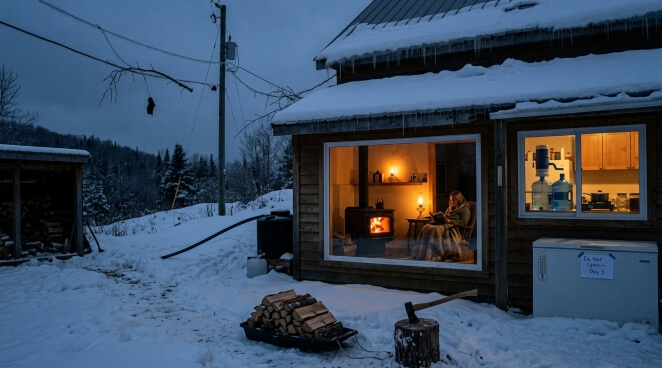
What fails first: the well pump (electric pump draws grid power; no power = no water), the refrigerator and freezer, electric heat if that’s the primary system, and any medical equipment. A rural household with wood heat, a gravity-fed spring, and preserved food is more resilient to extended power outages than one that runs entirely on grid infrastructure.
The Baseline Rural Emergency Kit
The baseline rural emergency kit: 72 hours of water (4 litres per person per day), 72 hours of non-perishable food, a manual can opener, battery or hand-crank radio, flashlights and spare batteries, first aid kit, 30-day supply of any medications, and a plan for anyone in the household who depends on electric medical equipment. Extending this to 7–10 days is more appropriate for rural properties on isolated distribution lines.
Emergency Water Storage for Properties Without Municipal Supply
Well pump failure is the most common and least-prepared-for rural emergency. Most rural wells in BC run on 240V electric pumps. No power, no water. The solutions, in order of cost: a generator capable of running the pump (starting load for a ¾ HP pump is roughly 2,000W; running load is around 800–1,000W), a hand pump installed on the same well as a backup, or stored water.
Stored water requirements: 4 litres per person per day for drinking and cooking. A family of four for 10 days requires a minimum of 160 litres. Food-grade containers, stored in a cool dark space away from direct sunlight, should be rotated annually. Water from a clean water source can be stored for up to 6 months in opaque sealed containers; commercially sealed water has a 2-year shelf life.
Prepping for Minor Emergencies vs. Extended Outages
Minor emergencies, 24–72-hour outages, a burst pipe in January, a road washout that blocks the driveway for two days, are common in rural BC and require modest preparation: the 72-hour kit, a generator for the pump and the freezer, and a supply of firewood already stacked and dry.
Extended outages require a different level of preparation. The freezer food problem becomes real after 24–48 hours if the power is gone and the freezer is full. A full, undisturbed chest freezer holds temperature for 48 hours; an upright for 24 hours. After that, the food either needs to be cooked and eaten, canned, or moved to a cold space. Food preservation methods that work without electricity – canning, dehydrating, salting – become relevant here as the reason to have a robust preserved food supply before an outage, not during one.
The most common prepping mistake rural households make is buying emergency supplies they don’t know how to use. A generator that was never started before the outage, a pressure canner still in the box, a water purification kit without any instructions. Buy for what the household actually knows how to do, then build skills outward.
Wildlife Conflicts on Rural Properties: Bears, Coyotes, and Smaller Animals
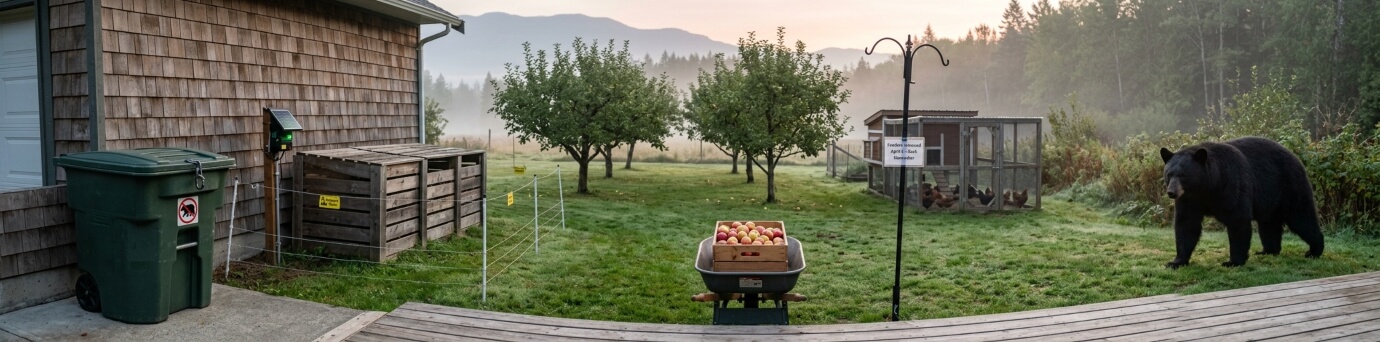
Every year hundreds of bears are destroyed in BC as a result of conflicts with people, and most of those conflicts begin with attractants – unsecured garbage, accessible compost, fruit trees left unharvested, and bird feeders left out after June. Under BC’s Wildlife Act, it is an offence to leave attractants accessible to dangerous wildlife. Conservation Officers can issue written orders requiring removal; failure to comply carries penalties of up to $50,000.
The practical homestead rules for bear country: compost in a bear-resistant container or electric-fenced enclosure; garbage stored in a secured building or bear-resistant bin until collection day; bird feeders brought in by April 1 in low-elevation coastal BC; fruit from trees harvested promptly or fallen fruit cleared daily during the August–October conflict season.
Coyotes on rural properties primarily target small livestock and poultry. The management is covered in detail at flock management. For larger wildlife, the BC Conservation Officer Service RAPP line is the correct contact: 1-877-952-7277.
Wildlife safety on a rural property starts with removing the reasons wildlife comes close, and that is a choice every household makes before a dangerous situation develops.
Tree Risk and Storm Preparedness on Forested Properties
Douglas fir and red alder are the two most common blow-down species in BC coastal windstorms. Douglas fir has the greatest structural mass and causes the most infrastructure damage when it fails. Red alder rots from the inside out and fails without obvious external warning – a standing alder with a dead crown is a hazard tree regardless of how the base looks.
The annual fall walk-around before storm season: identify any tree within falling distance of the house, outbuildings, vehicles, power lines, and access roads. For large trees within fall distance of critical structures, a certified arborist assessment is the appropriate next step – not visual inspection from the ground. BC Hydro spent $150 million on vegetation management in 2025, specifically because drought-stressed trees along distribution lines have been the primary cause of the record 2024 outage numbers.
Storm preparation for the homestead: chain saw serviced and fuelled before November, a week’s supply of firewood staged inside or in a covered area, the driveway clearance plan established before the first ice event, and the water storage level checked.
Rodent Control in Rural Kitchens and Food Storage Areas
Bananas, along with most ripe fruit, attract mice into kitchen areas – the ethylene gas and sugars from ripening produce are detectable by mice at significant distances. On a rural property where mice are a perennial reality rather than an occasional visitor, fruit left on countertops is a direct recruitment tool.
The most effective rodent control approach is the elimination of access and attraction simultaneously. Access: steel wool and expanding foam in any gap larger than ¼ inch (6mm) at the foundation, around pipe penetrations, and where the structure meets the ground. Attraction: all food stored in hard-sided containers (glass, metal, heavy plastic with sealed lids). Cardboard boxes and bags do not stop mice.
For the food storage areas associated with a preserved food supply – root cellars, pantry spaces, canning shelves – glass mason jars are inherently rodent-proof. Dried goods in fabric bags or paper packaging are not. Transfer any long-term stored grain, legumes, or dehydrated food to sealed glass or metal containers immediately.
Communication When the Grid Is Down
Cell towers typically run on backup power for 4–8 hours after grid failure. After that, cell service in many rural BC areas becomes unreliable or absent. Plan for communications without cell service.
Options in roughly ascending cost: battery or hand-crank NOAA/Environment Canada emergency weather radio ($30–80, receives broadcast alerts with no cell service needed); VHF marine radio if near water (also receives Coast Guard weather broadcasts); satellite communicator such as Garmin inReach or SPOT ($350–$500 device + subscription) for two-way messaging and SOS via satellite; and amateur radio (HAM) which requires a licence but provides communication networks that remain operational when commercial infrastructure fails.
Sign up for the Emergency Alert system for the local Regional District and for BC Hydro’s text/email outage notifications for the household account. These use cell broadcast when available and are the fastest official notification channel for wildfires, floods, and road closures. For context on how rural living affects emergency response times and access, see rural living realities.
Rural Emergency Contacts and Resources (BC)
- BC Hydro outage reporting: 1-800-BCHYDRO (1-800-224-9376) or bchydro.com/outages
- BC Conservation Officer RAPP line (wildlife conflicts): 1-877-952-7277
- BC Wildfire Service (wildfire reports): 1-800-663-5555 or *5555 on mobile
- Poison Control BC: 1-800-567-8911 (24/7)
- EmergencyInfoBC (disasters and evacuations): emergencyinfobc.ca
- PreparedBC (household emergency planning resources): gov.bc.ca/preparedbc