
The four methods of canning, dehydrating, salting, and smoking were standard household practice for most of human history. Refrigeration is roughly 100 years old. These four methods are considerably older, and they produce results that a freezer cannot: shelf-stable food that stores at ambient temperature, requires no power, and, in most cases, improves in character over time. For a rural household, a homestead garden, or an emergency food supply, they are not nostalgic techniques. They are practical infrastructure.
Why Food Preservation Without Electricity Matters
One grid failure, one deep freeze that dies in July, or one winter power outage is enough to lose a year’s worth of food if the entire supply depends on refrigeration. For households with kitchen gardens and livestock, or for anyone building a serious emergency plan, a preserved food supply that does not require electricity is not a contingency. It is the baseline.
Five ways to preserve food without electricity produce overlapping results with different trade-offs. Canning produces shelf-stable jars. Dehydrating produces lightweight, concentrated food. Salting and smoking produce preserved meat and fish with minimal equipment. Root cellaring requires no processing at all. A complete food preservation system uses all five; a beginner typically starts with two.
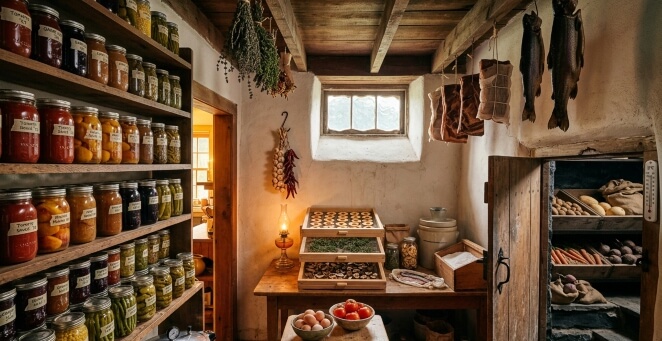
Water Bath Canning vs. Pressure Canning: Which Foods Need Which
The rule is determined by acidity, and it is not negotiable. High-acid foods, those with a pH below 4.6, including most fruits, jams, pickles, and acidified tomatoes, can be processed in a boiling water bath canner at 100°C (212°F). The acid prevents Clostridium botulinum spores from germinating, and the heat destroys yeasts, moulds, and most bacteria.
Low-acid foods (vegetables, meats, soups, beans, and any mixture of low and high acid ingredients) must be processed in a pressure canner at a minimum of 116°C (240°F). This is the only temperature at which botulism spores are reliably destroyed. Boiling water alone cannot reach this temperature. According to Health Canada, HealthLink BC, and the CDC, using a water bath canner for low-acid foods is not a safe substitute – it will not protect against botulism.
Botulism toxin is colourless, odourless, and tasteless. A contaminated jar may look, smell, and taste completely normal. The illness it causes can be fatal. Always use a pressure canner for low-acid foods and always follow tested recipes without substituting ingredients or changing processing times. Source: Health Canada, Home Canning Safety.
Water bath: peaches, pears, apples, berries, cherries, jams, pickles, relishes, acidified tomato products.
Pressure canning: green beans, corn, carrots, potatoes, all meats, stocks and broths, soups, stews, and mixtures containing both low and high acid ingredients.
At altitudes above 300 metres (1,000 feet), adjust pressure settings upward according to the manufacturer’s chart. Water boils at a lower temperature at elevation, which affects processing time for both methods.
Dehydrating Food: Times, Temperatures, and What Works Best
Dehydration removes moisture below the threshold that allows bacteria, mould, and yeast to survive. An electric dehydrator is the most consistent tool, but food can also be dried in a low oven, a solar dehydrator, or by air-drying on racks in a well-ventilated space. The USDA-recommended temperatures and times for common foods:
Food | Temp (°F) | Temp (°C) | Approx. Time |
|---|---|---|---|
Meat / jerky (pre-cooked to 160°F) | 160 | 71 | 4–6 hrs |
Tomatoes (sliced) | 135 | 57 | 6–12 hrs |
Apples (sliced, ¼ inch) | 135 | 57 | 6–12 hrs |
Berries (whole) | 135 | 57 | 12–18 hrs |
Herbs (leaves) | 95 | 35 | 1–4 hrs |
Mushrooms (sliced) | 125 | 52 | 4–8 hrs |
Bananas (⅛ inch) | 135 | 57 | 6–8 hrs |
Meat jerky requires special attention. The USDA recommends heating strips to an internal temperature of 160°F (71°C) either before or after dehydration. Dehydration alone at 130–140°F does not reliably reach this internal temperature even after several hours. Pre-cook in oven at 275°F for 10 minutes before drying, or finish dehydrated jerky in a 275°F oven for 10 minutes before storing.
Properly dehydrated food should snap, not bend. Moisture content at or below 10% produces shelf-stable product that stores in airtight containers at room temperature for 6 months to several years, depending on the food and storage conditions.
Salt Curing Meat: Ratios, Safety, and Storage Life
Salt cures meat by drawing out moisture and creating an environment hostile to spoilage bacteria. The basic dry cure ratio for pork is 2.5–3% salt by weight of the meat. For a 2 kg piece of pork belly, this means 50–60g of salt applied to the surface and worked in thoroughly. Pink curing salt (sodium nitrite, sold as Prague Powder #1) is added for most cured meats at a rate of 0.25% of meat weight – essential for inhibiting botulism in anaerobic curing environments and for preserving colour.
For traditional long-cure hams and bacons, the dry cure is applied to the surface, the meat is refrigerated or kept in a cold space (below 4°C / 40°F), and the cure is repeated every 2–3 days. Cure time is approximately 2 days per cm of thickness at the thickest point. A 5 cm thick piece requires a minimum 10 days of curing before it is safe.
Salt-cured meat that has been properly dried and stored in a cool, dark, ventilated space will keep for several months to over a year. The traditional method for salted fish (cod, salmon) involves complete coverage in coarse salt, which produces a shelf-stable product that lasts months without refrigeration.
Never use table salt alone for meat curing if long-term storage without refrigeration is the goal. Nitrites (from pink curing salt or curing mixtures) are essential to prevent botulism in anaerobic meat preservation. Follow tested recipes; this is not an area for improvisation.
Cold Smoking and Hot Smoking: The Difference and When to Use Each
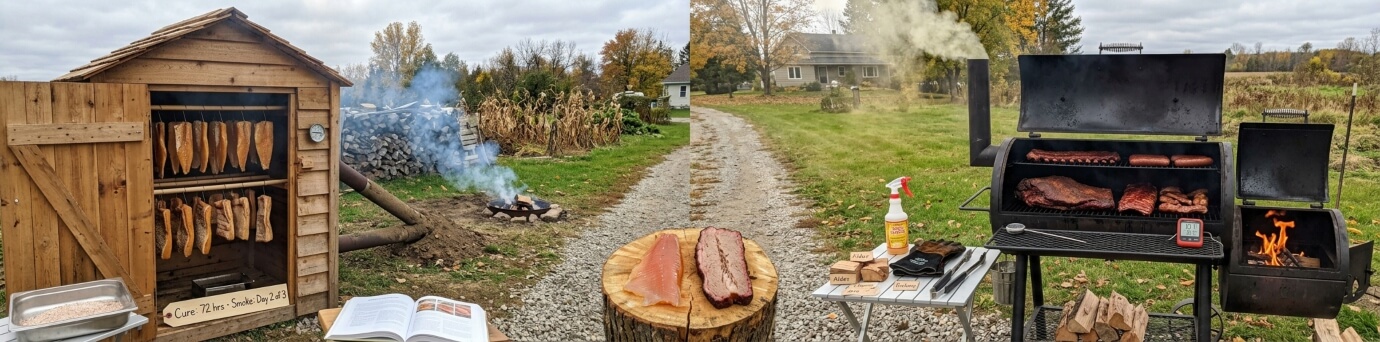
Cold smoking operates below 30°C (85°F) and is a preservation method. Hot smoking operates above 65°C (150°F) and is primarily a cooking method.
Cold-smoked products (salted fish, bacon, salmon, certain cheeses) are exposed to smoke for hours or days without reaching internal cooking temperatures. The smoke deposits antimicrobial phenols and aldehydes on the surface; the salt cure provides the primary internal preservation. Cold-smoked meat must be salt-cured first. Smoking without curing does not produce a shelf-stable product and creates conditions for bacterial growth.
Hot-smoked meat is cooked through during the process but is not shelf-stable on its own – the remaining moisture content is sufficient for bacterial growth at room temperature. Hot-smoked products should be treated as cooked, perishable food unless they are subsequently dehydrated to a moisture level below 10%. Jerky made by hot smoking followed by dehydration is shelf-stable; hot-smoked brisket is not.
Wood species matters for flavour but not safety: applewood, cherry, alder, and maple produce mild-to-medium smoke; hickory and oak produce heavy, robust smoke. Douglas fir and other conifers are generally avoided for food smoking due to resin content and bitter terpene compounds.
Root Cellar Storage: What Keeps and What Doesn’t
A root cellar works by maintaining temperatures between 0–4°C (32–40°F) and humidity between 85–95% through natural thermal mass and insulation. This is the opposite condition from most dry pantry storage: root vegetables, cabbages, and apples need the cold and humidity. Grains, dried beans, and canned goods need cool, dry conditions.
Stores well in a root cellar: potatoes, carrots, beets, turnips, parsnips, celeriac, cabbages, winter squash (cured first), apples (separately from vegetables – ethylene gas accelerates ripening), onions and garlic (dry, cool, well-ventilated).
Does not store well: tomatoes, cucumbers, eggplant, sweet peppers (all prefer above 10°C), and any produce showing signs of rot or disease – a single rotting potato will accelerate decay in surrounding ones significantly.
Living Without a Refrigerator
Pre-refrigeration households combined multiple preservation methods into a complete seasonal system: fresh food eaten first, preservation happening throughout the harvest season, and stored preserved food drawn down through winter. No single method replaced the refrigerator; the system did.
The practical modern translation: a root cellar or cold room for fresh storage in cool months, a deep freeze for the shoulder seasons when no other method applies well, and a substantial supply of canned, dried, and salt-cured products for the months when fresh food is unavailable and power outages are most likely. For how this connects to emergency preparedness and power outage planning, see the dedicated page.
One practical note on canning without electricity: water bath canning can be done on a propane burner, a wood stove, or an outdoor fire. Pressure canning can be done on any heat source that can maintain the required pressure. A wood stove that heats the home in winter can run a canning session simultaneously. For how to fuel that stove efficiently, see cord of wood and firewood basics.
Building a 3-Month Food Supply on a Realistic Budget
Start with what the household already eats. The most common mistake in building a food store is buying unfamiliar bulk foods that sit unused because no one knows how to cook them. A working food preservation system is built from the foods already in rotation, preserved and stored in greater quantity.
A basic 3-month supply for two adults, using a combination of the methods covered on this page:
- Canned goods: 24–36 quart jars of high-acid produce (tomatoes, fruit, pickles) + 24 pints of pressure-canned vegetables or beans. Budget: $80–$140 for jars and lids; food cost varies by garden production.
- Dehydrated: 4–6 kg of dried herbs, tomatoes, and fruit. 2–3 kg of dehydrated jerky. Budget: $20–30 for supplies if using a dehydrator already owned.
- Salt-cured: 2–4 kg of cured pork products (bacon, salt pork). Budget: $30–60 for pork belly + curing salts.
- Root cellar / cold room: 20–30 kg potatoes, 5–10 kg carrots, 5 kg onions, 3–5 kg winter squash. Budget: $60–$100 if buying; $15–25 if garden-grown.
- Staples (non-preserved): 25 kg flour, 10 kg dried beans/lentils, 5 kg rolled oats, 3 kg salt, 2 kg sugar, cooking fats. Budget: $120–$160.
Total budget for a functional 3-month supply built from scratch: approximately $350–$500 CAD, assuming jars and basic equipment are already owned. The supply builds in value year over year as equipment costs become sunk.