
Rural living does require a dramatic change of life, not a tweak. The commute disappears, yes. But so does the pharmacy three minutes away, the tradesperson who can come tomorrow, and the background hum of density that most people have never noticed until it’s gone. This page is for people who have already made the move or are about to.
The First Year: What Nobody Warns You About
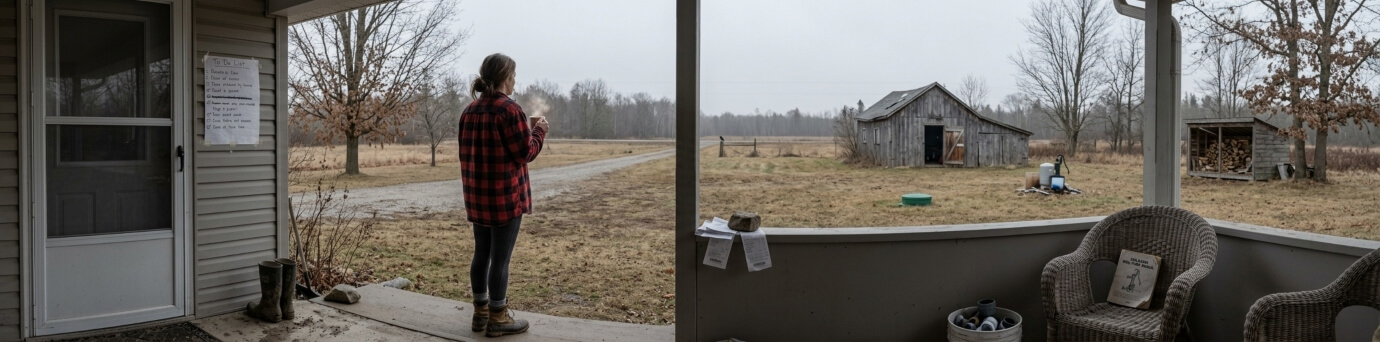
Not the physical demands. Not the weather. Not even the distances. The thing most city transplants report as the genuine surprise is the isolation, not in the abstract, but in the specific, daily sense of far fewer people around than they’d ever experienced.
“I think the hardest thing has been the isolation. I craved quiet, but sometimes it’s too quiet, as in no people around.” – reader comment, two years after moving to a rural property
This is not a failure of character. It is a structural shift. Urban life generates involuntary social contact at a density rural life cannot replicate. The grocery run, the coffee shop, the commute – all of those produced passive human contact that most urban people never counted as social interaction until it stopped happening. Rural social life is deliberately organised, not ambient.
The second most common first-year surprise is maintenance volume. A property with a well, a septic system, wood heat, a driveway, aging outbuildings, and several acres of land generates maintenance demands that have no urban equivalent. The first year tends to reveal everything the previous owners deferred. Budget for it, and treat the discovery of problems as information, not disaster.
Rural Living Skills: What to Learn and In What Order
Start with the kitchen, then work outward. This is the consistent advice from people who have been doing this for more than a decade. Food preservation (canning, dehydrating, fermenting, root cellaring) connects directly to the garden and pays off every day. It’s also forgiving: a batch of jam that doesn’t set properly is a minor loss. A flooded root cellar from a failed drain is not.
The second tier of rural living skills, in rough priority order: basic water system maintenance (well pump troubleshooting, pipe insulation, pressure tank maintenance), wood heat management (stacking, seasoning, chimney cleaning, recognising fire risks), and basic property mechanics (chainsaw safety, small engine maintenance, tractor operation if applicable).
The skills most often learned too late: first aid and wound care at a distance from urgent care, and wildfire/emergency preparedness specific to the property. Both are covered in more depth at emergency preparedness.
A Quora user who grew up off-grid put it plainly: “If you get seriously hurt off grid it can be fatal… I put it down to attentiveness, not taking risks, and arranging tasks so that injury is impossible or unlikely.” Rural living skills include knowing not just how to do things, but how to do them without getting hurt far from help.
The Challenge of Living in a Small Rural Home
Rural homes are, on average, older, smaller, and less finished than their suburban counterparts at the same price point. The challenge of living in a small rural home is not the square footage, it is the organisation. A house designed in 1960 for a farm family that worked outside most of the day functions differently for a remote-working family with two children and a home office. Storage is almost always the first constraint.
Old farmhouses also reveal problems seasonally. What seems fine in August becomes a draft problem in December. What looks dry in May becomes a moisture problem in March. A single visit to a property in any one season is not enough to know what it does in the others. The first year of rural living is, in part, a tour of the house’s seasonal behaviour.
The practical response: before doing anything decorative, map the actual use patterns of the space for at least one full seasonal cycle. Most urban transplants overestimate how much living space they need and underestimate how much functional working space – mudrooms, tool storage, cold storage, firewood staging – rural life requires.
Raising Children in the Country: What Changes
Raising a child in the country produces measurably different outcomes on some dimensions. A 2023 study published in Child Health and Human Development found that rural children were 97% more likely than urban children to be reported as living in a safe neighbourhood, 75% more likely to have a guiding mentor, and 29% more likely to volunteer regularly in their community.
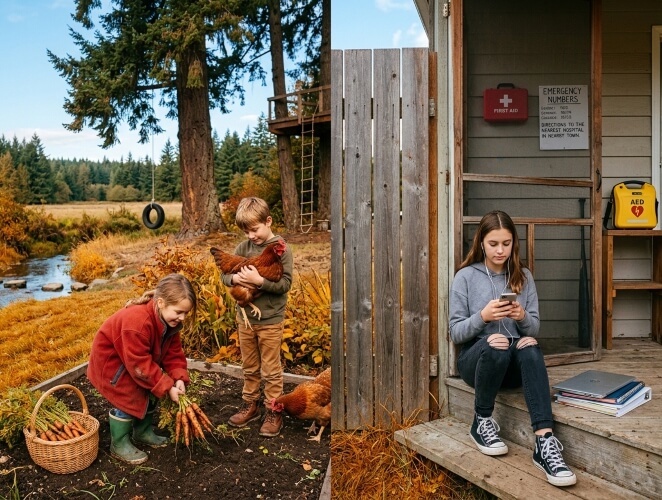
The tradeoffs are equally concrete. Emergency response times in rural Canada run 3–4 times longer than in urban areas. Ambulance response to a remote property in coastal BC can exceed 30 minutes. This is not an argument against raising children in the country – it is an argument for preparedness: knowing basic first aid, having a defibrillator if anyone in the household needs one, and knowing the fastest route to the nearest emergency department and its current operating status.
For children specifically, the adjustment is usually faster than for adults. Outdoor access, animals, physical work, and space are immediate gains for most children under twelve. Teenagers adjust more variably – social life in rural areas requires more effort to organise, and teenagers who were deeply embedded in urban peer groups sometimes find the transition harder than their parents do.
Country Sounds, Country Time: Adjusting Your Internal Clock
Rural time runs differently. Not slower, exactly – the days are full. But the structure of the day is determined by the property and the season rather than by external schedules. Sunrise matters. Sunset matters. The forecast for tomorrow matters in a way it never did before.
The first thing most people lose, and later miss least, is the ambient urban noise floor. Cities have a constant auditory background – traffic, HVAC systems, voices, construction – that disappears entirely in rural areas. For some people, this is an immediate relief. For others, the silence is disorienting for the first several weeks. One Quora contributor who moved from Seattle after 43 years described the adjustment:
“Where I live now, it’s quiet, and on cold nights when the crickets aren’t active, you can hear a single leaf drop from 100 feet away.”
That experience is almost universal. What varies is how quickly people decide they prefer it.
Rural living also shifts the relationship with darkness. Rural nights are genuinely dark. Power outages are more frequent and longer than urban ones. Having battery lighting, a wood stove or alternative heat source, and a plan for extended outages is not overcaution – it is standard preparation.
Finding a Mentor: Why It Matters More Than Books
Finding a suitable mentor is the single most efficient investment a new rural household can make. Not because books and online resources are inadequate, but because applied rural skills are highly local. The question of when to plant garlic in coastal BC, why the pump loses pressure in cold weather, how to fell a tree on a slope without it rolling – none of these have answers that transfer cleanly from one region to another. A neighbour who has farmed that specific microclimate for twenty years knows things that no publication does.
Grit magazine, whose writers have been covering rural mentorship for decades, put it clearly:
“Despite all of our preparations, we’ve learned it’s often difficult to apply book knowledge to our farm without the help of mentors and their years of experience. So, if I could offer only one piece of wisdom, it would be to seek and find capable mentors in all your endeavours.” – Grit.com
The practical challenge is finding one. The generation gap is real: experienced rural people and new rural arrivals often do not frequent the same places. Farmers’ markets, feed stores, and agricultural extension offices are the most reliable connection points. The best approach is usually simple and direct: ask someone whose operation you admire if they would be willing to answer questions. Most experienced rural people who love what they do will say yes.
Rural Living – Is It for Everyone?
Rural lifestyle appreciation is something you discover, not something you bring. People who report lasting satisfaction with rural life almost always describe specific things they’ve gained: growing food they eat, heating with wood they split, watching children learn to be physically capable, understanding how a property works across all its systems. These are active, tangible outcomes.
The people for whom rural living does not work tend to fall into two categories. The first: those who moved primarily to escape something urban rather than toward something rural. Escaping cost, density, or noise works for the first few months. It does not provide the ongoing motivation that rural maintenance demands.
The second category is those who discover, after arrival, that isolation is harder than anticipated for a specific member of the household. This is the most common reason people return to cities – not the physical work, not the distances, but one partner for whom the reduction in social density is genuinely depressing rather than liberating. This is worth discussing explicitly before the move, not after.
After a Year: What Stays Hard and What Gets Easier
At the twelve-month mark, most rural households report roughly the same pattern. What has become natural: the daily rhythms, the physical capacity, the relationship with the property’s systems. What remains hard: the social dimension, the unpredictability of rural maintenance costs, and, for households with remote work, the discipline of the home office without the separation a commute used to provide.
The most consistent gain at one year is competence. People who were city-dwellers twelve months earlier can now start a fire reliably, read their well pressure gauge, stack firewood correctly, manage a kitchen garden through to harvest, and handle minor property repairs that would previously have required a tradesperson. This is not a small thing. It is a genuine change in capability that compounds year over year.
The most honest summary: rural living does not get easier, exactly. It gets more capable. The problems of year five are different from the problems of year one, not fewer. But by year five, the household that has committed to the life and kept learning has built something that no urban equivalent offers: a place that works, that they understand, and that they largely run themselves. For backyard livestock as a starting point on that path, see backyard chickens basics.