
A full cord of wood measures 4 ft × 4 ft × 8 ft, exactly 128 cubic feet of stacked firewood. That’s the standard unit for buying and selling firewood across Canada. Every other term you’ll encounter (face cord, rick, rank, bush cord) is a variation of it, and some of those terms are used inconsistently by sellers. Knowing what a full cord means before you pick up the phone saves arguments and, reliably, money.
What Exactly Is a Cord of Wood?
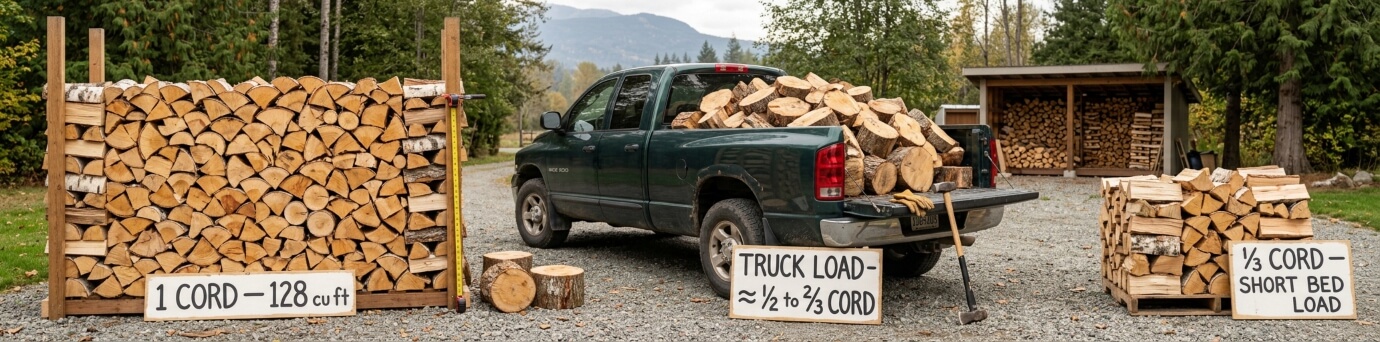
A cord is a legal unit of measurement in most Canadian provinces. The standard: a tightly stacked pile measuring 4 feet high × 4 feet deep × 8 feet wide, giving a gross volume of 128 cubic feet. But 128 cubic feet of stacked wood is not 128 cubic feet of solid wood, air space between pieces accounts for 20–40% of the total, depending on how carefully the wood is stacked. The actual solid wood in a full cord runs between 80 and 100 cubic feet, and a dry cord weighs roughly 2,500 to 5,000 pounds depending on species.
A full cord typically contains 600 to 800 individual logs. That’s a useful mental image of the scale before you buy.
One practical note: a standard short-bed pickup holds roughly one-third to one-half of a cord loaded level with the bed top. A heaping long-bed load might approach two-thirds. Ask sellers to quote by the stacked cord, not the truck load.
Face Cord vs. Full Cord vs. Rick – the Differences
Full cord (bush cord): 4×4×8 ft, 128 cubic feet. The standard unit. Always use this as your comparison baseline when getting quotes from multiple sellers.
Face cord (rick): A stack 4 ft high × 8 ft wide, but only as deep as the piece length, typically 16 inches. A face cord with 16-inch pieces is exactly one-third of a full cord, or about 42 cubic feet. The term “rick” is used inconsistently by region. Always ask the piece length before agreeing on a price.
Thrown cord: Wood tossed loosely into a truck without stacking. The extra air space means 25–30% less actual wood than the same volume stacked. If a seller quotes a thrown cord, adjust your expectations accordingly.
Unit | Dimensions | Volume | Fraction of Full Cord |
|---|---|---|---|
Full cord (bush cord) | 4 ft × 4 ft × 8 ft | 128 cu ft | 1.0 |
Face cord (16″ pieces) | 4 ft × 8 ft × 16 in | ~42 cu ft | 1/3 |
Face cord (24″ pieces) | 4 ft × 8 ft × 24 in | ~64 cu ft | 1/2 |
Half cord | 4 ft × 4 ft × 4 ft | 64 cu ft | 1/2 |
How Long Does a Cord of Wood Last in Winter?
There’s no single answer. Four variables determine the result, and each one shifts it significantly.
Stove efficiency. A modern EPA-certified wood stove delivers 70–83% overall efficiency. An uncertified pre-1990 stove delivers 40–60%. An open fireplace: roughly 10–15%. Heating with a fireplace instead of a stove can mean burning two to three times more wood for the same warmth.
Square footage. A 1,500 sq ft well-insulated home in coastal BC typically burns two to three cords per winter, roughly one cord per month from November through January. A poorly insulated house the same size might need four or five.
Insulation and air-sealing. A drafty older farmhouse and a tight modern cabin of identical size can differ by a factor of two in wood consumption. Sealing gaps around windows, doors, and penetrations before winter is one of the highest-return actions a wood-heat household can take.
Wood species. A cord of dry oak contains roughly 29.1 million BTU. A cord of dry Douglas fir contains roughly 20.7 million. That’s a 40% difference. A household burning fir needs considerably more cords than one burning oak for equivalent heat output.
Home Size | Insulation | Stove Type | Estimated Cords / Season (BC Coast) |
|---|---|---|---|
1,000 sq ft | Good | EPA-certified | 1.5–2.0 |
1,500 sq ft | Good | EPA-certified | 2.0–3.0 |
1,500 sq ft | Poor | EPA-certified | 3.5–4.5 |
2,000 sq ft | Good | EPA-certified | 3.0–4.0 |
2,000 sq ft | Poor | Old uncertified | 5.0–7.0 |
Interior BC, the Prairies, and Ontario winters are colder. Add 20–40% to these figures for colder climate zones.
Best Firewood Species Ranked by BTU Output
The heat content of firewood is measured in British thermal units (BTU) per cord. The figures below are for air-dry wood at approximately 20% moisture content.
Species | BTU per Cord (millions) | Weight / Cord (dry, lbs) | Notes |
|---|---|---|---|
White oak | 29.1 | 4,200 | High heat, slow-burning coals, low smoke |
Sugar maple | 29.0 | 3,700 | Excellent coals, easy to split |
Red oak | 27.3 | 3,800 | Widely available, strong all-round performer |
Yellow birch | 26.2 | 3,000 | Good heat, pleasant smell, splits well |
Big leaf maple | 24.5 | 3,200 | Best hardwood available on the BC coast |
Red alder | 19.8 | 2,540 | Clean burn, widely available coastally |
Douglas fir | 20.7 | 2,970 | Common in BC; more creosote than hardwoods |
Lodgepole pine | 17.1 | 2,400 | Low BTU; best as kindling, not primary heat |
Sources: Heating Value of Native Species of Wood, CDL Inc.; HY-C Company species comparison; USDA Forest Products Laboratory.
Douglas fir is the most available firewood species on the BC coast. It burns well – fast ignition, decent heat, pleasant smell. But it produces more creosote than hardwoods because of its higher resin content, which makes annual chimney inspection non-negotiable for households burning it regularly. Big leaf maple and red alder are the better options where available – cleaner burn, closer to hardwood performance.
How to Season Firewood, and Why Green Wood Is a Problem
Freshly cut wood contains 40–60% moisture by weight. Properly seasoned firewood for a wood stove should be at or below 20%. Green wood is difficult to ignite, burns incompletely, and produces significantly more creosote. Creosote buildup is the primary cause of chimney fires, and it’s a direct result of burning wood that hasn’t dried properly.
The single most effective thing a wood-heat household can do: cut and stack firewood in spring for burning the following winter. Six months of outdoor drying takes most BC softwoods from 40–60% moisture down to 18–22%.
How to season correctly:
- Split the wood first. Round pieces dry only from the outside; split pieces expose two internal grain faces and dry two to three times faster.
- Stack off the ground on pallets or rails. This prevents ground moisture from wicking up and improves airflow below the stack.
- Cover the top, leave the sides open. Blocking airflow slows drying. A tarp over the top is enough.
- Favour south-facing stacks for maximum sun exposure.
- Verify moisture before burning. A wood moisture meter costs $20–40 and gives a reading in seconds. Above 25% is not ready.
Douglas fir and red alder typically reach 20% moisture within 6–9 months under reasonable coastal BC drying conditions. Hardwoods (oak, maple) generally need 12–18 months.
Wood Stove Efficiency Ratings: What the Numbers Mean
Efficiency numbers on wood stoves are not what they first appear to be. Combustion efficiency, how completely the wood burns, is always higher, and is the figure manufacturers tend to advertise. Overall efficiency, how much of that heat actually reaches the room rather than going up the chimney, runs 10–20 percentage points lower. A stove advertised as ‘85% efficient” almost certainly means combustion efficiency; its overall efficiency may be closer to 68–75%. Overall efficiency is the number that determines how many cords you’ll burn.
Under the 2020 EPA emissions standard, all new certified wood stoves sold in North America must emit no more than 2.0 grams of particulate matter per hour. An uncertified pre-1990 stove typically emits 15–30 grams per hour – a 10× difference for the same heat output. Modern EPA-certified stoves achieve overall efficiencies of 70–83%, compared to 40–60% for older equipment. Replacing an old uncertified unit with a current model typically reduces wood consumption by 25–40%.
In Canada, any new wood stove installation or replacement should be followed by a WETT (Wood Energy Technology Transfer) inspection. Most Canadian insurers require a current WETT report for coverage on a property with a wood-burning appliance. A WETT inspection typically costs $200–$450, depending on location and complexity, and verifies clearances, chimney integrity, and appliance certification.
Indoor Firewood Storage: Keeping Wood Dry and Pest-Free
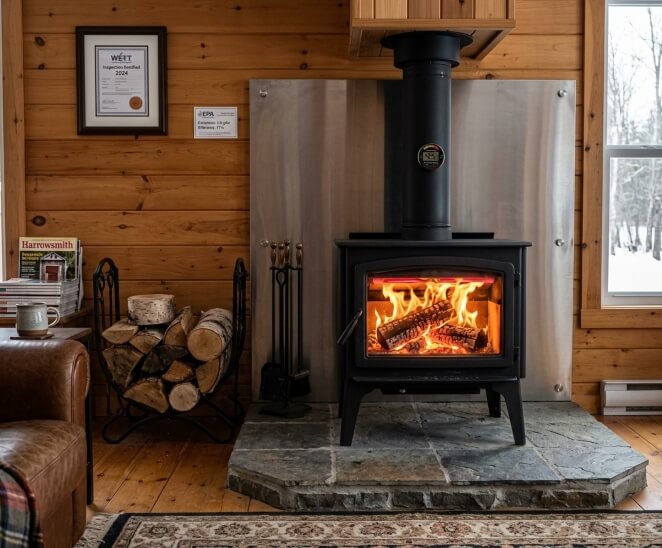
Insects (wood-boring beetles, carpenter ants) overwinter in firewood. Bringing a full season’s supply into a heated space in October can release hundreds of them into a house as temperatures rise. The practical answer is to store the bulk supply outdoors and bring in only a few days’ worth at a time. A small rack near the stove holding 24–48 hours of wood keeps the routine manageable without creating a pest problem.
For outdoor storage: off the ground, covered on top, sides open for airflow, at least 12 inches from any house wall or foundation. A dedicated firewood shed with a raised floor and solid roof is the best long-term solution in wet coastal climates.
How Much Firewood Do You Need for a Full Season?
Start with the square footage and insulation level, using the estimates in the table above. Then adjust for two factors.
Species. If the available wood in your area is primarily Douglas fir or pine, add 30–40% more cords to any estimate based on hardwood BTU. A household that would need two cords of maple needs closer to three cords of fir for equivalent heat.
Backup heat. Households relying entirely on wood heat need a minimum safety margin of one extra cord beyond the estimate. Shoulder seasons, extended absences, and unexpected cold snaps make that buffer worth having.
Item | Unit | Approximate Cost (BC, 2026) |
|---|---|---|
Mixed fir (delivered, split, seasoned) | per cord | $300–$420 |
Big leaf maple | per cord | $380–$500 |
Larch (interior BC) | per cord | $330–$450 |
Stacking service (optional) | per cord | $30–$80 |
WETT inspection (new installation) | per inspection | $200–$450 |
Wood moisture meter | one-time purchase | $20–$45 |
Prices from Kijiji BC listings and local suppliers, April 2026. For most coastal BC households, well-seasoned fir or big leaf maple at two to three cords for a 1,500 sq ft home is the working planning figure.
Order before October. The cost of a cord of firewood in September is consistently 15–25% lower than the same cord in December, and seasoned supply is largely spoken for by mid-autumn. Waiting until the first cold snap is the most expensive way to buy firewood.
For related reading: how wood heat fits into broader rural emergency planning is covered at emergency preparedness for rural households. For wood stove installation in a heritage log cabin, see log cabin restoration and homestead decor.