
Chickens produce at least 24 distinct chicken calls and vocalizations. Most backyard keepers learn three, and miss the rest entirely.
That catalogue of 24 calls was first assembled by ornithologists Nicholas and Elsie Collias at UCLA, who studied chicken communication from the 1950s through the 1980s. More recent research, including work by animal behaviour researcher Carolynn Smith at Macquarie University, suggests the number may reach 30. The point isn’t the exact count. The point is that a backyard flock is running a sophisticated communication system at all hours, and most of what it’s saying goes unnoticed by the people who feed it.
Understanding chicken sounds meaning, what each call signals and why, is more practical than it sounds. The alarm call that announces a hawk overhead is different from the alarm call that announces a fox on the ground, and the flock responds to each one differently. Knowing which is which takes about ten minutes to learn and can prevent a loss.
The Alarm Call, and Why It’s the First Sound to Learn

Chickens use two structurally different alarm calls for two structurally different threats, and this distinction is one of the best-documented findings in poultry behaviour science.
The aerial alarm, triggered by a hawk, eagle, or any object moving overhead, is a short, high-pitched shriek. Hens respond to it by crouching low and running toward cover, scanning upward. It is fast and urgent.
The ground alarm – triggered by a raccoon, fox, dog, or anything moving at ground level – is the repetitive, low clucking that most people associate with chickens in general. That familiar “cluck-cluck-cluck” sound is actually a warning signal. Hens responding to it stand upright in a vigilant posture and scan horizontally.
The distinction was documented in controlled lab experiments by Chris Evans and colleagues at Macquarie University in 1993, using video stimuli of a soaring raptor and a ground-level raccoon. Hens responded with measurably different postures and movement patterns depending on which call was played back. The calls are, in Evans’s framing, functionally referential – they encode specific information about the type of threat, not just its presence.
Roosters do not reflexively sound the aerial alarm every time they spot a hawk. Research from Smith’s lab, using wireless microphones attached to birds, showed that roosters survey the situation first: if females are nearby, they usually call. If they are alone, they often don’t. The alarm is a social decision, not an automatic reflex.
Knowing the difference also changes how you call chicken back to safety: responding to a ground alarm with calm movement is different from responding to an aerial shriek.
Contented Clucking vs. Something Else
The rhythmic, low-frequency clucking a flock produces during normal foraging is the baseline sound of a settled, undisturbed group. Birds cluck softly and steadily while moving across a yard. The tone is unhurried. The frequency stays consistent.
Distress sounds different in register and rhythm. A bird that is separated from the flock, trapped, or handled produces louder, more irregular calls at a higher pitch. A young bird separated from its mother produces a distinctive, repetitive distress peep – high-pitched, continuous – that is recognisable even to people with no experience of chickens.
Quiet is also information. A flock that goes suddenly and completely silent, especially mid-morning when birds are normally active, often signals that something has caused collective freezing behaviour. This can follow an aerial alarm call that went unheard by the keeper. A quiet flock that doesn’t move to food when offered it is worth investigating.
The Egg Song: What the Research Says
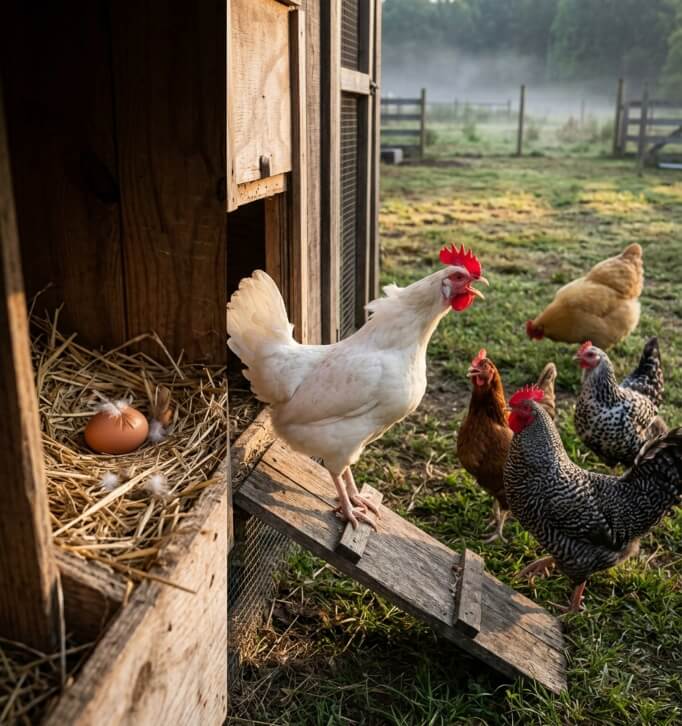
After laying an egg, most hens produce a series of loud, staccato calls, the “buck-buck-buck-baa–daaack” sound that can last anywhere from one to fifteen minutes. Other hens, and sometimes the rooster, often join in. The result is one of the louder events in a typical backyard flock’s day.
The egg song is one of the most observed chicken behaviours and one of the least understood. Despite its familiarity, there is almost no controlled research into its function. Several hypotheses circulate, none definitively proven.
One suggests the call draws predator attention away from the nest and toward the now-mobile hen, a decoy function. Another proposes it signals the rooster for escort back to the flock, which matches what is observed in wild jungle fowl (*Gallus gallus*), where hens laying away from the group call for the cock to return them safely. A third interpretation focuses on reproductive timing: one research summary from the University of Maryland Extension notes that the post-laying cackle may signal to males that the hen is currently less receptive to fertilisation.
What the research agrees on: the egg song is not simply pride or relief, despite those being the most common anthropomorphic explanations offered in popular sources. Its acoustic structure is specific and consistent across individuals and breeds. Its exact communicative function remains an open question in poultry science.
Not all hens produce it. Breed variation is significant – Australorps and Leghorns tend toward louder egg songs, Orpingtons and Bantams are generally quieter. And the sound occurs in contexts beyond laying: hens produce it when anticipating being let out of the coop, when a familiar person arrives, or when another hen occupies the preferred nest. It is a broader social signal than its common name implies.
What Your Rooster Is Saying
The rooster’s crow is the most audible sound in any flock and also the most misunderstood. It is widely assumed to happen at dawn. In practice, roosters crow throughout the day in response to a range of triggers: other roosters (real or recorded), perceived territory challenges, ambient noise, and sometimes no apparent cause at all.
Tidbitting is a separate sound – a series of low, rapid clucking calls the rooster produces while finding or showing food to hens. He typically drops his head and pecks at the ground repeatedly while producing the sound. Hens approach and feed. It is one of the clearest examples of intentional food communication in the species.
Roosters also produce a low, repeated call when escorting hens or when patrolling the perimeter of a ranging area. This differs acoustically from tidbitting and from alarm calls. Learning to distinguish a patrol call from a low-level alarm call takes time but is useful, the former is relaxed and regular; the latter carries more urgency and often stops the hens from moving.
A Mother Hen Talking to Her Chicks
The vocalisations between a broody hen and her chicks begin before hatching. Hens produce soft, low purring sounds while sitting on eggs in the final days before hatch. Chicks respond from inside the shell. This pre-hatch vocal exchange is documented in poultry research – it appears to synchronise hatch timing and establish early acoustic recognition between mother and offspring.
After hatch, the mother hen uses distinct calls for specific purposes. A soft, rhythmic clucking draws chicks toward her and signals safety. A sharper, louder call tells chicks to freeze or run to shelter. Chicks respond to the maternal alarm call from the first day post-hatch, they are precocial birds with no adaptation period, and the alarm response is functional immediately.
The food call – a rapid, excited series of clucks while pecking at food – teaches chicks what is edible. Hens produce it selectively, more frequently when the chicks are young and inexperienced. As the brood ages, the food call frequency drops.
Broody Hens: The Low Growl and What It Means
A broody hen, one sitting on eggs or settled in the nest box in a hormonal laying-down posture, produces a distinctive low growl when approached. It sounds like a continuous, low-frequency rumble with occasional sharper notes. The frequency and intensity increase if the person or bird continues to approach.
This is not a random aggressive sound. It is a specific deterrent vocalization produced by a hen in a physiologically different state from her normal flock behaviour. The broodiness hormones that drive the sitting behaviour also drive the defensive vocalization. Removing a broody hen from a nest, which is sometimes necessary for flock health, typically triggers the growl immediately and intensifies it throughout handling.
First-time keepers sometimes mistake the broody growl for a sign of injury or illness. It is neither. It is a reliable indicator that the hen is broody, not that she is unwell. A broody hen off the nest, eating normally, and returning to the nest box within a few hours is behaving exactly as expected. For more on managing a broody hen within a flock, see flock management.
Sounds That Might Indicate a Sick Bird
Disclaimer: this section describes behavioural patterns, not diagnostic criteria. Any bird showing signs of illness should be evaluated by a veterinarian. Vocalisations alone cannot diagnose disease.
A bird that has gone notably quieter than its normal baseline, particularly one that separates from the flock and stands hunched, is showing a behavioural pattern consistent with illness in many species, including chickens. Sick birds conserve energy and reduce social communication. The change in baseline vocalization is often the first thing a keeper notices.
Respiratory illness can produce audible changes: a wet, gurgling breathing sound, wheezing, or clicking. These are sounds of the respiratory system under stress rather than intentional vocalisations. They are not the same as normal calls and are usually accompanied by visible signs – discharge, laboured breathing, reduced activity.
A chick that produces continuous, high-pitched distress peeping without being separated from the group, and that is not warmed up or settled by being returned to the heat source, may be experiencing stress beyond normal hunger or cold. For guidance on backyard chicken health and flock basics, see the dedicated page.
12 Chicken Sounds in One Table
Sound | When It Occurs | What It Indicates | Typical Duration |
|---|---|---|---|
Aerial alarm (high shriek) | Hawk or raptor overhead | Immediate cover-seeking; flock crouches | 1–2 seconds, then silence |
Ground alarm (rapid clucking) | Ground predator nearby | Flock stands alert, scans horizontally | 10–60 seconds |
Contented foraging cluck | Normal ranging activity | Flock settled and undisturbed | Continuous, low-level |
Egg song (post-lay cackle) | After or near laying | Function debated; flock and rooster join in | 1–15 minutes |
Broody growl | On nest, disturbed | Hen is broody; deterrent response | As long as disturbance continues |
Tidbitting (rooster) | Food found | Rooster directing hens to food source | 10–30 seconds |
Pre-lay sing | Before entering nest to lay | Hen signalling readiness; anticipation | 5–20 minutes |
Maternal food call | Mother with young chicks | Teaching chicks to eat; drawing them in | Brief, repeated |
Distress peeping (chicks) | Separated, cold, or frightened | Chick needs heat, contact, or security | Continuous until resolved |
Pre-hatch purring | Final days on eggs | Synchronising hatch; establishing acoustic bond | Intermittent |
Rooster patrol call | While ranging | Low-level monitoring; not alarmed | Ongoing, relaxed rhythm |
Quiet–then–freeze | After aerial alarm | Collective predator response; flock motionless | Variable |