
Moving to the country is a long-held dream for a lot of Canadians, and a genuine step change in how daily life works. The planning phase is where most of the important decisions happen. Escaping the rat race is one thing. Arriving somewhere that has no reliable internet, a failed septic system, or ALR zoning that prevents you from doing anything you planned is another. This page covers the decision and preparation stage.
Why People Move to the Country?
The challenge of living in a small rural home, or any rural home, is not the isolation, the distances, or the physical demands. Those can all be planned for. The challenge is usually the gap between what a person imagined the life would be and what it actually requires. It’s definitely not for everyone, and the people who say that are not being elitist. They are describing a real attrition rate.
The people who stay are almost always those who arrived with a specific set of things they wanted to do: heat with wood, produce food, raise animals, build something. The people who leave most often are those who moved primarily to get away from something – costs, noise, density – rather than toward a specific kind of life. Moving from city to country to escape the rat race is a reason. It is not a plan.

10 Things to Confirm Before You Buy Rural Property
In roughly the order they should be checked:
- Well water quality and flow rate. Test for bacteria, nitrates, and heavy metals. A reliable well delivers at least 5 GPM. Request the well log from the seller.
- Septic system condition. Hire a certified septic specialist – not a general home inspector. Septic replacement costs run $60,000–$100,000+ in Canada. This is not optional due diligence.
- ALR status in BC. Check the BC Land Title and Survey Authority – whether a property is inside the Agricultural Land Reserve determines what you can build, subdivide, and operate on it.
- Internet options at the specific address. Check Starlink coverage and existing tower maps for the property address directly. General regional availability means nothing.
- Distance to the nearest emergency department. And whether it is consistently open. Rural ED closures in BC occurred more than 120 days in 2022 alone.
- Zoning and permitted uses. What the property is zoned for determines what structures, businesses, and activities are legally permitted. Confirm with the Regional District.
- Road maintenance status. Is the access road maintained by the municipality year-round, or does it become impassable after snowfall or spring melt?
- Heating system and fuel source. If the property uses propane or oil, what is the delivery reliability? If wood heat, what is the local supply and cost?
- Property history. Any unpermitted structures, prior ALR violations, or outstanding orders from the Regional District can become your liability at closing.
- Neighbours and easements. Right-of-way issues and contentious boundaries are common on rural properties. Review the title certificate for registered charges before offering.
Rural Real Estate: What Urban Buyers Miss on the First Visit
Most urban buyers spend the first property visit looking at the house. Rural real estate due diligence is largely about the land and the infrastructure. A beautiful kitchen is irrelevant if the well fails, the septic is undersized, and the road washes out in April.
First-visit questions worth asking: How old is the well and what does the flow log show? Where is the septic leaching bed and when was the tank last pumped? Are there any registered easements or rights of way across the property? Is any part of this land inside the ALR? Has the municipality issued any orders or notices against this property in the past five years?
The rural property market in Canada has compressed significantly since 2020. Bidding pressure that was most acute in 2021–2022 has eased in most markets, but rural property prices near major urban centres (the Okanagan, the Cowichan Valley, the areas within two hours of Toronto) remain elevated. Budget realistically for what the land costs to operate, not just to purchase.
Internet, Healthcare, and Emergency Services: Research Before You Commit
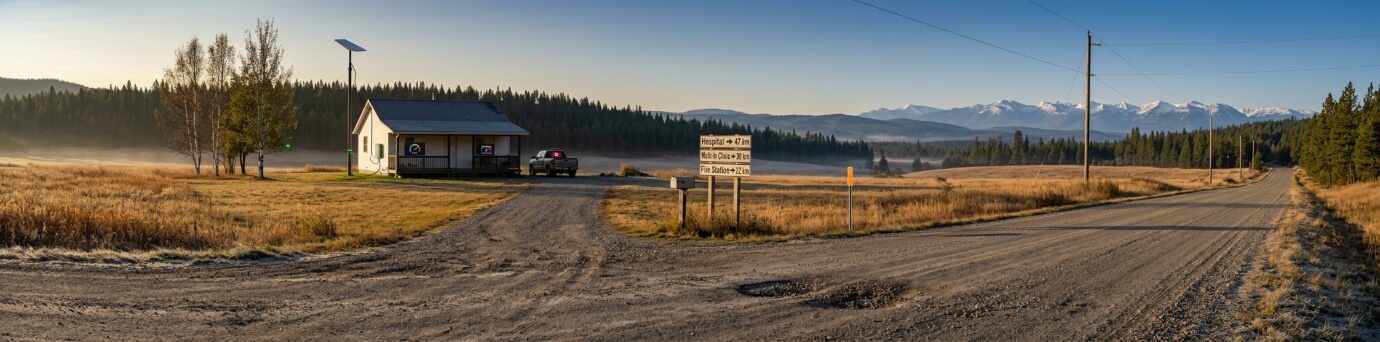
These three infrastructure gaps end more rural moves than anything else. Not because the gaps are insurmountable, but because people discover them after signing.
Internet: Starlink covers 100% of Canada as of 2025, costs CAD $140/month (plus a one-time $759 hardware fee), and delivers 50–220 Mbps. For properties far from tower coverage, it is the realistic option. Check the specific address, not the region. Traditional rural providers in most areas offer 25 Mbps or less.
Healthcare: approximately 20% of Canadians live in rural communities, but only 8% of physicians practice there (CMA, 2025). Rural Canadians travel over 35 km on average to see a doctor. Research the nearest GP, nearest walk-in, and nearest emergency department, and check its hours and recent closure history, before committing to a property.
Emergency services response times in rural areas are measured in tens of minutes, not the 5–8 minutes of urban areas. This affects fire insurance rates, liability for certain property uses, and practical planning for medical emergencies.
ALR Zoning and Rural Land Restrictions in British Columbia
The Agricultural Land Reserve covers 4.6 million hectares, or about 4.9% of BC’s land base. Within the ALR, agriculture is the designated priority use. Non-agricultural uses and subdivisions are generally not permitted without approval from the Agricultural Land Commission.
What is permitted on ALR land without ALC approval: farming and agricultural uses, one principal residence (capped at 500 m² total floor area as of ALC Information Bulletin 05, revised June 2024), and one additional residence per parcel (capped at 90 m² for properties 40 ha or smaller, or 186 m² for larger properties). Agri-tourism and on-farm processing are permitted under specific conditions.
What requires ALC approval or is generally prohibited: subdividing ALR land, non-agricultural commercial operations, structures that do not support farm use, and residences that exceed the size caps. Since September 2020, private landowners can no longer apply directly to the ALC to exclude land from the ALR – that path now runs through local governments only.
Buyers who purchase ALR land without fully understanding the restrictions sometimes find that the structures they planned to build, the business they intended to run, or the lot they hoped to subdivide are all prohibited under the ALC Act. The ALC Act takes precedence over local zoning bylaws. Confirm ALR status and permitted uses before making an offer.
Running a Business from a Rural Property
Rural properties are attractive for home-based businesses: space, quiet, and separation from residential neighbours. The limitations are less obvious. Zoning determines what commercial activities are permitted, and inside the ALR, non-farm commercial uses require ALC approval. Some Regional Districts restrict home-based businesses to low-traffic service businesses and prohibit retail, manufacturing, or high-employee-count operations.
Internet reliability is the other constraint. Remote work that depends on video calls, file uploads, or cloud systems needs consistent high-speed access. Starlink is functional for most professional uses but is not equivalent to fibre. Test the connection at the specific property during the inspection period if internet-dependent work is part of the plan.
The True Cost of Country Living vs. City Living
Is country living cheaper? It depends entirely on what is being compared. Property purchase prices are often significantly lower than comparable urban properties. Operating costs are different in kind, not necessarily in total.
Urban households pay for transit, parking, convenience services, and dense infrastructure maintained by municipal taxes. Rural households pay for vehicle maintenance (rural roads are harder on vehicles), fuel (longer distances), propane or heating oil, well and septic maintenance, snow removal equipment, and property maintenance that a landlord or strata previously handled. The rural budget should include a mechanical contingency of at least $5,000–$10,000 per year for equipment, infrastructure, and emergency repairs that urban renters never encounter.
The break-even on lower property purchase price versus higher operating costs varies significantly by lifestyle and location. People who produce a substantial portion of their own food and heat with wood on land they own outright often come out well ahead. People who replicate urban consumption patterns in a rural setting often do not.
A Moving Checklist: What to Do in the 90 Days Before You Relocate
- Confirm internet options at the specific address and arrange setup before the move date. Do not assume coverage.
- Establish a relationship with a GP or walk-in clinic before you arrive, not after. Rural healthcare panels are often full; register early.
- Order firewood or heating fuel in advance. First-winter supply needs to be in place before October.
- Test the well water and have the septic pumped as part of the pre-closing process, not afterward.
- Update vehicle insurance for rural use; rates and coverage types differ from urban policies.
- Register for emergency notification systems in the local Regional District (wildfire alerts, flood warnings, road closures).
- Source a reliable local plumber, electrician, and general contractor before you need one in an emergency.
- For what the first six months actually look like after the move, see adjusting to rural living: what actually changes.